MUSIC REVIEW BY Jack Bowers, All About Jazz
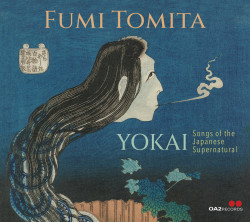
In 2023, seeking solace after the recent death of his father, bassist and composer Fumi Tomita began exploring the artwork in a book of woodblock Japanese images that his wife had given him, and found in them the inspiration for an album devoted to exploring the mystical realm of Japanese spiritualism from a jazz perspective.
Tomita, a New Yorker of Japanese descent, wrote nine themes based on his understanding of Japanese supernatural beliefs and recorded them with his quartet in August 2025 at a studio in Amherst, Massachusetts. The resulting album, Yokai, encompasses a series of unique and at times ethereal sketches in which Funita's resonant bass often plays a leading role. When it does not, those tasks are left in the capable hands of saxophonist and flautist Carl Clements, guitarist Jason Ennis and drummer Gary Fieldman.
Thanks in large measure to Tomita's special skills as a composer and arranger, these Japanese-centered motifs blend easily into a jazz format, and the listener need not worry about Tomita or his companions wandering too far afield. To the contrary, the music is generally luminous and accessible, and few listeners would be likely to suspect its ancestry unless informed beforehand.
The song titles, however, are entirely Japanese, from the opening "Daija" (Monster Snakes) to the swaggering finale, "Hyakki Yagyo" (Night Parade of 100 Demons). In between are such word poems as "Kitsune" (The Fox), "Wakana-Hime" (Princess Wakana), "Genju Zukushi Emaki" (Beasts Galore) and four more charmers. Clements, an impressive soloist, plays tenor sax on three numbers, flute on two, alto on "Kiyomon," soprano on "Hiyakki Yago" and sits out "Daija" and the even-tempered "Okiku," wherein Ennis solos astutely and Fieldman shows off his burnished brushwork.
Setting aside its provenance, Yokai is basically an album of contemporary jazz, ably performed by a seasoned quartet whose members welcome the Japanese idiom while remaining laser-focused on the jazz heritage. It is a bright and pleasing merger.
Tomita, a New Yorker of Japanese descent, wrote nine themes based on his understanding of Japanese supernatural beliefs and recorded them with his quartet in August 2025 at a studio in Amherst, Massachusetts. The resulting album, Yokai, encompasses a series of unique and at times ethereal sketches in which Funita's resonant bass often plays a leading role. When it does not, those tasks are left in the capable hands of saxophonist and flautist Carl Clements, guitarist Jason Ennis and drummer Gary Fieldman.
Thanks in large measure to Tomita's special skills as a composer and arranger, these Japanese-centered motifs blend easily into a jazz format, and the listener need not worry about Tomita or his companions wandering too far afield. To the contrary, the music is generally luminous and accessible, and few listeners would be likely to suspect its ancestry unless informed beforehand.
The song titles, however, are entirely Japanese, from the opening "Daija" (Monster Snakes) to the swaggering finale, "Hyakki Yagyo" (Night Parade of 100 Demons). In between are such word poems as "Kitsune" (The Fox), "Wakana-Hime" (Princess Wakana), "Genju Zukushi Emaki" (Beasts Galore) and four more charmers. Clements, an impressive soloist, plays tenor sax on three numbers, flute on two, alto on "Kiyomon," soprano on "Hiyakki Yago" and sits out "Daija" and the even-tempered "Okiku," wherein Ennis solos astutely and Fieldman shows off his burnished brushwork.
Setting aside its provenance, Yokai is basically an album of contemporary jazz, ably performed by a seasoned quartet whose members welcome the Japanese idiom while remaining laser-focused on the jazz heritage. It is a bright and pleasing merger.
Soundclips
Other Reviews of
"Yokai: Songs of the Japanese Supernatural":
Jazz Weekly by George W Harris
The New York City Jazz Record by Marilyn Lester
Paris Move by Thierry De Clemensat