MUSIC REVIEW BY Katchie Cartwright, All About Jazz (Interview)
Following a years-long recording hiatus, Brazilian-born Seattle-based Grammy- nominated pianist and composer Jovino Santos Neto released three albums in 2025, all captured live. Two are digital-only releases, both recorded in 2024: Retratos: Brazilian Portraits (Audiophile Society), a duo performance with Estonian bassoonist Martin Kuuskmann in a program of great Brazilian composers, and A Onça e o Pajé (Self- Produced), recorded live at the Amazonas Green Jazz Festival with the Amazonas Band conducted by Rui Carvalho.
In conversation with All About Jazz, Santos Neto focused on his third release of 2025, Mais Que Tudo: Live at Kerry Hall 1995 (Origin Records), which documents an extraordinary concert in Seattle 30 years prior, shortly after he had completed a 15-year stint with the great Brazilian composer-improviser Hermeto Pascoal and had subsequently relocated to the Pacific Northwest. An edited excerpt of the conversation is below.
Settling in Seattle
All About Jazz: Let's talk a little about the moment of this concert and leading up to it, and then now, the moment when you're releasing it, and what that means to you. We can talk a bit about the individual tunes, about the band, and what's next. I'd like to focus mainly on the recording, but there is so much to talk about. I was just reading a couple of things on your Substack blog, including your tribute to Hermeto Pascoal after he passed, and also the story of how you met him. Both of them are so charming, and then that beautiful reel of your granddaughter and you improvising at the piano as part of your Advent series on social media—oh, so lovely. So that's my mood and mode at present.
Jovino Santos Neto: Cool! Very good.
AAJ: Let's just start with the concert and maybe leading up to the concert. Julian Priester invited you to become a student at Cornish College, a music school in Seattle, in 1993, but that was two years before this. How long had you been preparing for this concert?
JSN: What happened is that I came as a student at the end of 1993, but I only took two semesters, because right in the middle of 1994 I was invited to teach there, at Cornish College of the Arts. It works out that I got my paperwork and visa that allows me to teach, and actually the whole immigration thing went very easily, miraculously. I started to teach and, even before I was teaching, within a couple of weeks of my arrival, there was no piano at my house, so I would practice at the school.
I would find an empty room with a piano and I would just play it by myself. And, slowly, people—other teachers—started to gravitate and say, "Whoa, what is this?" And one of the first people who showed up was the late Chuck Deardorf, the bassist who is on the recording. And he says, "Hey, can I get my bass?" And I say, "Of course, man. Come along and I will show you some songs," which I did. And then he brought in a horn player, Hans Teuber. This was happening within a couple of months. So by December of 1993, Chuck booked, out of his own pocket, a studio, and we went and recorded a demo. Then he invited this drummer, Mark Ivester, to join us in the studio. So we did this recording in December, and by this time I was so inspired by these musicians who wanted to play with me that I started to compose.
In Hermeto's band, I was playing 95% Hermeto's music, but now it was like my own compositional faucet got turned on and I started to just write. The inspiration was so big because I was writing for these guys, and they all wanted to play the music. And so practically every Friday— because the school had no classes on Friday afternoons and the rooms are empty—we would find a room with a piano and play, play, play. And, because I was so inspired, I would write more music and the next Friday we would play and play. So it turns out that, over the whole year of 1994, that's all we were doing; we were rehearsing and playing, and I was writing. So these were things that really came strongly.
AAJ: Did you use... I'm assuming you did use some of Hermeto's methods when you were rehearsing your own band?
JSN: Oh, yeah.
AAJ: What things did you bring from that experience?
JSN: Well, first of all, what Hermeto did is that he always would write music for our band thinking of our band. So, as a pianist, he would write something for me that was not exactly what I could play, but something a little beyond what I could play. That always gave you a challenge, but never a challenge that was so big and so deep that I would feel bad about it and not practice anymore because I knew I would never play this. He would do something that I could say, "If I practice a lot I can play this thing." And when I had achieved that and I thought I was already on top of the world, he would give me another one that was a little bit longer and a little bit deeper, a little bit more complex.
So I learned that from Hermeto and started to give this music to those guys. Of course, I was from Brazil and none of them were; they are all American jazz players. But I didn't try to teach them 'Brazilian' music by saying, "Here's how we play Brazilian music." I never did that. I would bring the song and say, "This is how I feel this song. How do you feel it?" Fortunately, all of them had amazing musicianship and they didn't try to play what we call "gringo samba" (laughs). They didn't try to do the general bossa nova that jazz players do. I was giving them challenging music, I was writing bass lines, but I never once took the drumsticks from Mark and said, "Here's how you do this." I let him figure out how he wanted to play it. And I was very happy with it, because not only was it real, but it was them, with their musicianship, playing this music instead of me projecting out to them what I thought they should play. So that means that I was surprised by the way they played it, and I also liked it.
Concert at Kerry Hall
This led to us playing more and more and building up a repertoire over the year, and by the end of 1994, Chuck— because he was a professor at Cornish, one of the top guys there; I was just a sub—he said: "Hey, we can do a concert here. They have a series and a little budget, and we can do a little concert of our quartet." So that concert was announced for the 28th of April 1995, which was my son's 13th birthday.
So we prepared, we rehearsed, and I did not even know that they had— because it was in the school and the theater—that they had already set up mics and recording gear. They recorded in eight tracks, digital. And at the end, after the show, they gave me a couple of video cassettes, "Here's the show we did."
AAJ: Really?
JSN: Yes. There is a video. And one day I will have to edit, or have somebody to edit, and add the sound of the master rather than just the audio-video, but yes. And then they gave me the tapes, which were like videotapes but with audio. It was not ADAT, but they had a system, I forgot what it was called. It was a Panasonic system that you can record on the 8-milimeter videotape. You can record eight channels of digital audio; that's what they used. Well, I didn't have the machine at home, so I just put them in a box under my bed. I literally slept on it for 15 years. And in 2010, cleaning out the house, we found—me and my wife—found the things and said, "Oh, I forgot those tapes." At that time, the school still had a machine to reproduced that kind of thing, so I said, "Wow, I want to do this." So I took it to school, transferred it to the computer, to regular audio files that you could use, like a digital audio workstation, ProTools. So I transferred it to ProTools, put it on a hard drive, and forgot about it again in 2010.
Another 15 years went by with me sleeping on top of the hard drives, until 2024. After Chuck passed away, I thought, "Oh, wait. I think I have a recording of the band at Cornish." So I went to find it, and it was there, and everything was great. So I asked my son-in-law, my daughter's husband, who is a producer, a young guy. I said, "Hey, man, would you like to mix this thing?" He is a real producer, has all the things, the plug-ins and all the things. So he listens and says, "Wow, this is fantastic; the music is so good." So he did some work on it and sent it to me. I listened and said, "That's pretty good, but let's do a little more of the bass here, a little more of this thing there," and he did it. And I was very happy with it. So Chuck had passed away, if I'm not mistaken, in 2023, and we really wanted to honor Chuck and thought this would really be a great way; to put out this concert. I had already left Cornish. I left at the beginning of the pandemic, in 2020.
But the hall where it happened was about to be sold. The whole building was about to be sold to a condo or something. And it turns out that Seattle Theater Group bought the building to make a community arts center. So they have rehearsal rooms, podcast rooms, dance studios, music studios in the building. So the building went back to its original purpose, which was to create music, to create dance and theater. And they helped me. They actually gave me a small grant that helped me to do the master and do the work. And then Origen music liked it and said, "Let's put out a CD." So they did the work, I had a master, and the rest is history as they say.
AAJ: The sound is great.
JSN: Yeah, it sounds fantastic. We didn't have to do much work on it. The sound was preserved, maybe by me snoring on top of it, I don't know.
AAJ: Haha, yes. Things happen in the night, when you're not looking or listening.
JSN: Gremlins.
The Tunes
AAJ: Let's talk a little bit about the tunes. I was struck by the opener, "Metamorph." So Hermeto, you know? You want to talk a little about that tune?
JSN: Yes, I remember exactly which room I was in at Cornish when I composed that tune. I was just practicing a shape on the piano (sings). So I wrote this whole thing down and had no idea where it was going. That's part of our Hermeto. We start composing without a form in your head, without a fixed plan. The music leads itself. And so it became a choro. So the way it was metamorphosing into different areas I liked very much. It was a very dancing tune, and the band played it so nice, I was very happy. This was recorded, as you know, in April of '95. A few of these tunes, including "Metamorph" and a few others that are on this live record, we recorded in the fall of 1996, like a year and a half after this, so they're there and it was a recording in which, you know, it's a little more controlled. We are separated, in different rooms. But the live experience... I mean the very first note of "Metamorph" is so strong that it distorts. It actually sounds like a heavy metal.
AAJ: Metalmorph.
JSN: Exactly. That's a good one. So probably the guy who was recording, he didn't even know we were going to hit so hard, because that was the first tune of the concert as well.
AAJ: The energy is palpable. You can really feel it in the room as well as on the bandstand in this.
JSN: Yep. The public had no idea. They didn't know who I was. I mean, they had started to hear about me. Chuck told a lot of musicians, a lot of people. I remember, Michael Shrieve (drummer with Santana) was in the audience. A whole bunch of musicians came to see who this guy is, and so that frisson, that electricity was there. Imagine, we spent a year rehearsing. It was like a pressure cooker, then we take off that valve and it explodes. Not only my energy, but everybody. Mark, the drums, the saxophone, the bass, we're all playing with such pleasure, playing this music together. So that is really what inspired me to release this thing. Because this is such a document. We have all changed and Chuck has passed away, sadly. I mean I'm a different player now. But, still, listening to that energy... In a way, it inspires me today to remind me to not lose that energy ever; the intensity of the music and the love and pleasure of making the music. To never let it get too jaded, to say, "Oh, I know exactly what I'm going to do, because I'm a veteran." So this, for me personally, works as a reminder that I could play like that and that I can still play like that, with the added benefits of the experience of 30 years on top of it.
AAJ: Yes, yes. How big is the room that you were playing in, how many people?
JSN: It only fits a hundred or so. Maybe 100 in the bottom and another 30 or 40 on the top, on the mezzanine. So it's not a giant room, but it's a very live room back in those days. Then they did some acoustic treatment, but this was before that, so it was a very live room. It was a room made for acoustic classical music.
AAJ: It sounds like the room was pretty full.
JSN: Yes, it was a full house, and that helps, too.
AAJ: And so it was musicians, and who else came?
JSN: A lot of the other teachers who taught at the school, with a lot of students, because these concerts are always free for the students. So back in those days the school probably had a hundred students, so they came. And it was so much fun because everybody was excited, I remember. I remember the next day. I was playing in Airto Moreira and Flora Purim's band at the time, and I think I had to leave for a tour the day after. I remember getting a phone call from Michael Shrieve, who says, "I was at that show, and I was blown away by the energy of you guys." Michael was the drummer for Santana at Woodstock; he lives in town.
AAJ: I didn't know.
JSN: Michael came and said, "What an amazing job, so inspiring." So that was a whole thing, the buildup, the way the energy came together. So we love it because of that.
AAJ: So tell me, going on to the next tune, "Mais Que Tudo," I'm assuming that's kind of a play on "Mas Que Nada?"
JSN: Exactly, yeah.
AAJ: And that's an expression I never really fully understood. I mean, what's the difference between those two?
JSN: You say "mas que nada" when you wave something off; "Come on, get out of here." So on the original tune by Jorge Ben it's "Get out of here, I want to pass." You wave it out of the way. But "mais que tudo," is "more than everything." So it's kind of romantic while it is a pun of the name but it's also something that you prize, that you cherish more than everything else. That one I wrote back in Brazil, before I moved to Seattle.
AAJ: Ah, OK. And what about "Caranavalha?" What is that?
JSN: I wrote that one in Brazil, too, around carnaval time, so it was another play on words and the word "carnaval." "Cara" means face, "navalha" means razor blade.
AAJ: Ah, I see. And "Chorelético?"
JSN: That one I wrote also in Brazil, and it was a choro. And Pernambuco, a percussionist in Hermeto's band, used to call me the "electric man" because I was always very restless, very energetic. But instead of saying, "elétrico" he would say "elético." So I just used his way of talking and put "Choreletico."
AAJ: OK. That was confusing me, because I was expecting it to be "Chorelétrico."
JSN: Haha. You're the first person who is asking those things. I appreciate that.
Pascoal and Jabour
AAJ: I remember the story you told about him in your Substack piece about meeting Hermeto. Pernambuco was calling himself "Pele" at the time and Hermeto said, "No, that's not going to work for you."
JSN: Yup. Yeah, exactly.
AAJ: And also the fact that Hermeto would have him grab different percussion instruments, not use the ones that he had but...
JSN: Exactly, Hermeto had him sell his conga, sell his berimbau. "There's enough people playing those things; you're going to play the sewing machine and the spring from a truck suspension." And we made our own percussion out of found objects, you know, keys and coins and bottle caps. That was percussion...
AAJ: Also, to stay with that story for a second, why were you in Jabour (area of Rio where Hermeto lived)? Did you go into Jabour to find Hermeto or were you living there?
JSN: Actually, I was born and grew up in Realengo, in the west zone of Rio. So about five miles away from Jabour is where my parents lived. I spent three years living in Canada doing my biology studies. When I came back to Brazil in 1977, it was with the intention of pursuing my postgraduate college. But I met my friend, my best friend that I grew up with lived in Jabour. He's the one who told me, "Hermeto lives in that house there." We were sitting down, happy to reconnect after all the years I was away in Canada, so that's why I went to Hermeto's house, that whole story that I told about meeting Hermeto. When I started to play with Hermeto I actually bought a bike. I was about a 20- minute bike ride from my house to Hermeto's and back and forth. So I was commuting by bike and afterwards I got married and went to live even farther out, in a farm, and had to take three buses to get there, from Jabour to this place. But then, eventually, after about a year and a half, we moved, me and my wife, back to Jabour, just down the street from Hermeto, same street, but just a block away.
AAJ: That's great. I love the story of you sitting there for 20 minutes, silently watching and listening to him practice, after Ilza had let you in to meet him. And then he just smiled and looked at you, you spoke a little, then he had you play something immediately. He said "Well, OK, we need a little work here, but come play with us... "
JSN: That was Hermeto.
AAJ: Totally amazing. And another thing that impressed me about that story was that you rehearsed for that first concert with him, you rehearsed and rehearsed and rehearsed, then he comes out with "Quebre tudo" (break everything), and you're not going to play anything that you rehearsed!
JSN: That was a big awakening, to realize that actually you cannot have any kind of plan or prediction, because Hermeto is such an intuitive player. And I asked him. I said, "So we're not going to play those tunes?" And he said, "Nah, not tonight, no." And so I go, "So why did we rehearse them?" But that's his thing, he was preparing.
A lot of the music we rehearsed we never performed. Or not recorded. Right now, I'm actually in the process of going through the entire archive of Hermeto's compositions for the group and preparing them, because the group, Hermeto's band, want to make a record dedicated to Hermeto with the music that has never been recorded. So I'm preparing the charts as we speak.
AAJ: That sounds like a lot of work.
JSN: It is.
AAJ: Yeah, so many tunes. I didn't realize that you were the archivist for the group.
JSN: I am. I have a file folder. That's one thing that I did when I left Hermeto's band. I said, "This music, I have to care for it, because if I didn't do it, not Hermeto, nobody else would do it." So I had a friend, this guy who worked in a Xerox place, where they do copies, you know, for lawyers and that kind of stuff, engineering. And I made a deal with him, in which I paid him a fixed price. And I would bring in duffel bags full of music. And then he would go after business hours and he would spend like 23 hours photocopying everything from the duffel bag and returning with the originals, which I would give back to Hermeto's archive, which I created, and I would save the copies, all double-sided, which means they didn't take as much room.
So when we moved to Seattle, me, my wife and two kids, we had about six suitcases. Two or three of them were just scores, copies of scores. And that, still, today lives in a special place in my bedroom, a file cabinet, all organized by a system of letters and numbers that I created. And I made a database, which for a while was lost because it was in a computer that there was no equivalent. And then I found a guy online who said, "I can transfer anything to anything else." So it was on one of those big floppy disks, you know, those big ones? And I said, "I have a floppy disk with a database created in Brazil in 1993." He said, "Send it to me." I did mail it to him, and he immediately sends me back a CD with the whole thing and an Excel with everything that was in there. It's amazing. The guy saved my life, because now I have the database in a format that can still be shared and edited and notes added, everything that I did.
AAJ: We don't have to spend much time on this, but I hadn't realized that Hermeto had a role in your deciding to marry. How did you meet your wife?
JSN: (Laughs) Well my wife is Swiss, and she was doing a trip through all of South America. She started out in Argentina, and she made her way all through Brazil, São Paulo, to the Northeast, to the Amazon, all the way up to Los Angeles. Took her nine months, backpacking with a companion. And I met her at the bus station in Rio. I already knew that I was going to be in Switzerland the next year, at Montreux. So I met her in '78. So we met at that time, and the chemistry was perfect and it was beautiful, but she went back to Switzerland, and I continued to live in Rio. But she came to Montreux and Hermeto saw us together and he held us and said, "Now you guys, I don't know if you know this, but you really belong together." It was crazy, backstage, '79. And then a few months later, in 1980, she came to visit, and she's still visiting. (laughs)
AAJ: What a great story.
JSN: Forty- six years married this year.
The Band and the Brazilian Sound
AAJ: So now, moving on to the two Hermeto tunes you played at the concert. First, "Candango." First, I have to say that Hans Teuber is quite amazing.
JSN: Oh, yeah.
AAJ: What a sound and, you know, it really is like he was born to the music.
JSN: Yeah, let me say something about this, because I think that it is very important. One thing that I found is that, here in the United States, there's amazing horn players, saxophone, you know. They have incredible technique and know the tradition of jazz, but the greatest majority of them, whenever confronted, whenever offered the opportunity to play this music, they will immediately switch to some kind of version of bebop. Hans didn't have that. Hans really embraced this music, not as jazz tunes, but as what it was. So he was not trying to be authentic Brazilian, because that doesn't really exist. But he put it his own way, and his own sound, which has some of that Paul Desmond sweetness. He's not that aggressive player that has that raunchy sound, but at the same time, has an amount of energy that's so brilliant.
AAJ: Yes.
JSN: So everything he played was fine. I was also playing some flute. There were some tunes that did not make it to the record, which we played two flutes together. But "Candango" is a piece that Hermeto wrote for the flutes and was recorded in the album Só Não Toca Quem Não Quer (Som da Gente, 1987), which was a xote, so we read it in a different way.
AAJ: So let me ask you this, because that's another one I don't really know how to translate... "only those don't want to play, don't?" Or how do you translate that?
JSN: Yeah, so again there are many different ways of interpreting that. Basically, literally, it means "only the people who don't want, don't play," but Hermeto wrote in this way, like "Music? If you really want to play the music, you're going to play the music." But it was also a very veiled jab at radio programmers, who love Hermeto's music. The labels would send the records to all the DJs, and they would take the record home, but they would never play it on the radio. So Hermeto would say, "You don't play my music on the air because you like it too much, you don't want" (to share it). So you'll notice that on the original release, each track is dedicated to a different DJ, a different music journalist from Brazil. In a way, Hermeto was being dismissed as being a true hermetic. Too scary, too weird, too strange, even though songs like that are simple songs that people can sing; children sing songs like this (sings a melodic fragment of "Candango"). So that was Hermeto, playing with the words.
AAJ: And what about "Haja Juntas?"
JSN: Well this track was a highly technical piece that Hermeto wrote that, piano-wise, is crazy. I mean, any instrument. It has quintuplets like (sings fast passage). And harmonically it's very advanced. So I wanted to play it with a whole band, but in the end found out that me and Hans really locked it in, so I decided just to throw it in just as a piano-saxophone duo; no improvisation, nothing. We just played three times each time a little faster. And there's a fantastic drum solo that connects "Candango" with that tune. So "Haja Juntas" used to be called "Queda de Braço," which means arm wrestling, because when you play it, your arm is quite... But "junta" means the joints of your fingers, so "Haja Juntas" means you have to have your joints in really good shape to play this thing.
AAJ: OK, makes sense. Also, just going back to Hans for a moment, the sound of his flute playing, the articulations on that particular tune are really his own. He slides where it was not slid before.
JSN: Oh, yeah.
AAJ: And also when he plays soprano, he really has his own sound.
JSN: Very much so. And I lost Hans from the band because, first of all he's so good, and then he got hired to play with Ani DiFranco. He went on tour with her, so that's when I couldn't have Hans in the band any more, and then—when he came back—he became the musical director for this... it's kind of a dinner circus thing called Teatro ZinZanni. They have it in Chicago, so he was the director for that. He became very busy in the show. He played all the instruments: bass, flute, saxophone, clarinet, keyboards. So it became a fulltime job for him to direct because the former director passed away; he inherited that position.
So I see him once in a while and we play together when it's possible. But actually, we have the idea of recreating this concert; Hans, Mark, me and a very good bassist in Seattle called Chris Symer. At the same hall again.
AAJ: Oh, that would be wonderful.
JSN: I don't know when. Sometime soon, but it's cooking on the fire.
AAJ: And was Hans teaching at Cornish at that time?
JSN: Yeah, Hans taught for a while, but he was never a career teacher, he was more like an adjunct. He was fantastic, and everybody loved him, but he was always wanted in a lot of bands, obviously.
AAJ: Well the chemistry here is just fantastic.
JSN: Oh, fantastic. Hans is awesome. Also on our record Caboclo (Liquid City Records, 1997); it's the same band. There are moments there, of our weaving in and out of each other. I listen to it today and I say, "How did we do that?" We couldn't have planned it. We reach the same note at the same time. Yeah, I have a big pleasure playing with Hans. It doesn't happen very often, but when it does, it's amazing.
AAJ: And before this concert it sounds like he did an awful lot of listening to Hermeto as well.
JSN: I'm not even sure. But he comes from a family of musicians. His father was a French horn player who grew up in South Carolina. His mother was a vocal teacher, so he was surrounded by music in a very nice way and then he played with Buddy Greco. So he always ran on the outside of the jazz bebop thing. He was a little more lyrical player and that's one thing that attracted me to his playing, because he didn't have that sound. And until today, I've had very few horn players. That's why I have a vibraphonist in my Quinteto currently.
AAJ: Right. Actually, I thought that he was European, either German or Swiss or Austrian or something.
JSN: South Carolina, from a German family.
AAJ: Really! Interesting. So let's move on to "Hoping for the Day."
JSN: That one I wrote dedicated to Chuck. I had been in Seattle just maybe a couple of months or something. Chuck was a very unique character. If you didn't know Chuck, you would think he was a very irrational kind of guy, because at times he would look like he was up to... He didn't want to laugh; he didn't want to joke. He would pass by you, and you say, "Hey, Chuck" and he'd just go, "Hmm." And it happened that one day he behaved like that I thought, "Did I say something wrong?" And I felt bad, because I liked him so much, immediately I felt there was a big affinity. That was the beginning of our friendship. But afterwards I started to understand that actually Chuck and I had a very similar sense of humor. So we would develop our own repertoire of jokes. Chuck had alternate titles for all of my tunes, which were really funny. He was one of the funniest guys I've ever met, but I didn't know how to crack the code, so I wrote that song thinking of him and the bass line (sings), that melody; he took to it right away. He owned that melody.
AAJ: So the birthday tribute, that was for your son? Did you plan to do that, or was it a surprise, impromptu?
JSN: Yes. I just told the guys it's my son's birthday. Let's do happy birthday for him, but as a samba. So we did it that way. It was just a celebration at the end of the concert. He was 13 years old. Now he's going to be 44.
AAJ: So you just called a key and said let's do happy birthday.
JSN: I did not even call a key, just started playing and they jumped in.
AAJ: That's wonderful. I just didn't know if it was something you had prepared in advance.
JSN: Haha. No.
Other Projects
AAJ: Well thank you so much. I think we're almost done, but maybe we can talk a little bit more about recent projects and what's next for you. You've mentioned a few things, but what would you like to leave us with?
JSN: Well, 2025, after so many years without doing any recording, without any record release at all, I released three records in 2025, so I think each one of them points to a different kind of work. The first one of them was recorded the previous year, 2024, in Estonia, with the bassoonist from Estonia. So this is a project where we do Jobim, we do different composers, with bassoon and piano, which is a very unique combination. Not very common to play Brazilian music. And this guy is amazing. He's not a jazz player. He's a classical player of the highest caliber who has music dedicated to him by Arvo Pärt and he's a virtuoso who tours the world and plays with orchestras; Mozart, Schubert, whatever. So that was one record.
Then, I went to Mannaus, Brazil, in the Amazon, and I was invited to play in the festival that they had there, the jazz festival, with a big band from Amazonas. And this was a big opportunity. That was also in 2024. I did, for the first time, a public recording of my big band arrangements, not only my music but one by Hermeto, one by Jobim, one by Dorival Caymmi, and the rest are all my tunes. So that was so beautiful, and it was recorded in this historical theater from 1897, during the rubber boom in Brazil. It's a mini replica of the Paris Opera, gorgeous theater. Pristine condition, fantastic pianos, in the middle of the Amazon. So I felt so good I actually went back in 2025 to release the CD and to play again with the same orchestra. I'm in love with that place. It's so beautiful, so different from everywhere else; different from Rio, the heart of the Amazon.
AAJ: Isn't that where you were going to study when you were a biologist, before you met Hermeto?
JSN: Exactly! You see how the ends meet? What you think is going to be a long road becomes a circle, a spiral, because I went back to the place where I was going to study when I started to play with Hermeto, now, to play my own music.
AAJ: Yeah, amazing.
JSN: Funny how that works.
AAJ: As you said, the music leads itself.
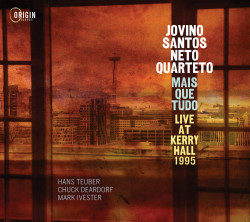
In conversation with All About Jazz, Santos Neto focused on his third release of 2025, Mais Que Tudo: Live at Kerry Hall 1995 (Origin Records), which documents an extraordinary concert in Seattle 30 years prior, shortly after he had completed a 15-year stint with the great Brazilian composer-improviser Hermeto Pascoal and had subsequently relocated to the Pacific Northwest. An edited excerpt of the conversation is below.
Settling in Seattle
All About Jazz: Let's talk a little about the moment of this concert and leading up to it, and then now, the moment when you're releasing it, and what that means to you. We can talk a bit about the individual tunes, about the band, and what's next. I'd like to focus mainly on the recording, but there is so much to talk about. I was just reading a couple of things on your Substack blog, including your tribute to Hermeto Pascoal after he passed, and also the story of how you met him. Both of them are so charming, and then that beautiful reel of your granddaughter and you improvising at the piano as part of your Advent series on social media—oh, so lovely. So that's my mood and mode at present.
Jovino Santos Neto: Cool! Very good.
AAJ: Let's just start with the concert and maybe leading up to the concert. Julian Priester invited you to become a student at Cornish College, a music school in Seattle, in 1993, but that was two years before this. How long had you been preparing for this concert?
JSN: What happened is that I came as a student at the end of 1993, but I only took two semesters, because right in the middle of 1994 I was invited to teach there, at Cornish College of the Arts. It works out that I got my paperwork and visa that allows me to teach, and actually the whole immigration thing went very easily, miraculously. I started to teach and, even before I was teaching, within a couple of weeks of my arrival, there was no piano at my house, so I would practice at the school.
I would find an empty room with a piano and I would just play it by myself. And, slowly, people—other teachers—started to gravitate and say, "Whoa, what is this?" And one of the first people who showed up was the late Chuck Deardorf, the bassist who is on the recording. And he says, "Hey, can I get my bass?" And I say, "Of course, man. Come along and I will show you some songs," which I did. And then he brought in a horn player, Hans Teuber. This was happening within a couple of months. So by December of 1993, Chuck booked, out of his own pocket, a studio, and we went and recorded a demo. Then he invited this drummer, Mark Ivester, to join us in the studio. So we did this recording in December, and by this time I was so inspired by these musicians who wanted to play with me that I started to compose.
In Hermeto's band, I was playing 95% Hermeto's music, but now it was like my own compositional faucet got turned on and I started to just write. The inspiration was so big because I was writing for these guys, and they all wanted to play the music. And so practically every Friday— because the school had no classes on Friday afternoons and the rooms are empty—we would find a room with a piano and play, play, play. And, because I was so inspired, I would write more music and the next Friday we would play and play. So it turns out that, over the whole year of 1994, that's all we were doing; we were rehearsing and playing, and I was writing. So these were things that really came strongly.
AAJ: Did you use... I'm assuming you did use some of Hermeto's methods when you were rehearsing your own band?
JSN: Oh, yeah.
AAJ: What things did you bring from that experience?
JSN: Well, first of all, what Hermeto did is that he always would write music for our band thinking of our band. So, as a pianist, he would write something for me that was not exactly what I could play, but something a little beyond what I could play. That always gave you a challenge, but never a challenge that was so big and so deep that I would feel bad about it and not practice anymore because I knew I would never play this. He would do something that I could say, "If I practice a lot I can play this thing." And when I had achieved that and I thought I was already on top of the world, he would give me another one that was a little bit longer and a little bit deeper, a little bit more complex.
So I learned that from Hermeto and started to give this music to those guys. Of course, I was from Brazil and none of them were; they are all American jazz players. But I didn't try to teach them 'Brazilian' music by saying, "Here's how we play Brazilian music." I never did that. I would bring the song and say, "This is how I feel this song. How do you feel it?" Fortunately, all of them had amazing musicianship and they didn't try to play what we call "gringo samba" (laughs). They didn't try to do the general bossa nova that jazz players do. I was giving them challenging music, I was writing bass lines, but I never once took the drumsticks from Mark and said, "Here's how you do this." I let him figure out how he wanted to play it. And I was very happy with it, because not only was it real, but it was them, with their musicianship, playing this music instead of me projecting out to them what I thought they should play. So that means that I was surprised by the way they played it, and I also liked it.
Concert at Kerry Hall
This led to us playing more and more and building up a repertoire over the year, and by the end of 1994, Chuck— because he was a professor at Cornish, one of the top guys there; I was just a sub—he said: "Hey, we can do a concert here. They have a series and a little budget, and we can do a little concert of our quartet." So that concert was announced for the 28th of April 1995, which was my son's 13th birthday.
So we prepared, we rehearsed, and I did not even know that they had— because it was in the school and the theater—that they had already set up mics and recording gear. They recorded in eight tracks, digital. And at the end, after the show, they gave me a couple of video cassettes, "Here's the show we did."
AAJ: Really?
JSN: Yes. There is a video. And one day I will have to edit, or have somebody to edit, and add the sound of the master rather than just the audio-video, but yes. And then they gave me the tapes, which were like videotapes but with audio. It was not ADAT, but they had a system, I forgot what it was called. It was a Panasonic system that you can record on the 8-milimeter videotape. You can record eight channels of digital audio; that's what they used. Well, I didn't have the machine at home, so I just put them in a box under my bed. I literally slept on it for 15 years. And in 2010, cleaning out the house, we found—me and my wife—found the things and said, "Oh, I forgot those tapes." At that time, the school still had a machine to reproduced that kind of thing, so I said, "Wow, I want to do this." So I took it to school, transferred it to the computer, to regular audio files that you could use, like a digital audio workstation, ProTools. So I transferred it to ProTools, put it on a hard drive, and forgot about it again in 2010.
Another 15 years went by with me sleeping on top of the hard drives, until 2024. After Chuck passed away, I thought, "Oh, wait. I think I have a recording of the band at Cornish." So I went to find it, and it was there, and everything was great. So I asked my son-in-law, my daughter's husband, who is a producer, a young guy. I said, "Hey, man, would you like to mix this thing?" He is a real producer, has all the things, the plug-ins and all the things. So he listens and says, "Wow, this is fantastic; the music is so good." So he did some work on it and sent it to me. I listened and said, "That's pretty good, but let's do a little more of the bass here, a little more of this thing there," and he did it. And I was very happy with it. So Chuck had passed away, if I'm not mistaken, in 2023, and we really wanted to honor Chuck and thought this would really be a great way; to put out this concert. I had already left Cornish. I left at the beginning of the pandemic, in 2020.
But the hall where it happened was about to be sold. The whole building was about to be sold to a condo or something. And it turns out that Seattle Theater Group bought the building to make a community arts center. So they have rehearsal rooms, podcast rooms, dance studios, music studios in the building. So the building went back to its original purpose, which was to create music, to create dance and theater. And they helped me. They actually gave me a small grant that helped me to do the master and do the work. And then Origen music liked it and said, "Let's put out a CD." So they did the work, I had a master, and the rest is history as they say.
AAJ: The sound is great.
JSN: Yeah, it sounds fantastic. We didn't have to do much work on it. The sound was preserved, maybe by me snoring on top of it, I don't know.
AAJ: Haha, yes. Things happen in the night, when you're not looking or listening.
JSN: Gremlins.
The Tunes
AAJ: Let's talk a little bit about the tunes. I was struck by the opener, "Metamorph." So Hermeto, you know? You want to talk a little about that tune?
JSN: Yes, I remember exactly which room I was in at Cornish when I composed that tune. I was just practicing a shape on the piano (sings). So I wrote this whole thing down and had no idea where it was going. That's part of our Hermeto. We start composing without a form in your head, without a fixed plan. The music leads itself. And so it became a choro. So the way it was metamorphosing into different areas I liked very much. It was a very dancing tune, and the band played it so nice, I was very happy. This was recorded, as you know, in April of '95. A few of these tunes, including "Metamorph" and a few others that are on this live record, we recorded in the fall of 1996, like a year and a half after this, so they're there and it was a recording in which, you know, it's a little more controlled. We are separated, in different rooms. But the live experience... I mean the very first note of "Metamorph" is so strong that it distorts. It actually sounds like a heavy metal.
AAJ: Metalmorph.
JSN: Exactly. That's a good one. So probably the guy who was recording, he didn't even know we were going to hit so hard, because that was the first tune of the concert as well.
AAJ: The energy is palpable. You can really feel it in the room as well as on the bandstand in this.
JSN: Yep. The public had no idea. They didn't know who I was. I mean, they had started to hear about me. Chuck told a lot of musicians, a lot of people. I remember, Michael Shrieve (drummer with Santana) was in the audience. A whole bunch of musicians came to see who this guy is, and so that frisson, that electricity was there. Imagine, we spent a year rehearsing. It was like a pressure cooker, then we take off that valve and it explodes. Not only my energy, but everybody. Mark, the drums, the saxophone, the bass, we're all playing with such pleasure, playing this music together. So that is really what inspired me to release this thing. Because this is such a document. We have all changed and Chuck has passed away, sadly. I mean I'm a different player now. But, still, listening to that energy... In a way, it inspires me today to remind me to not lose that energy ever; the intensity of the music and the love and pleasure of making the music. To never let it get too jaded, to say, "Oh, I know exactly what I'm going to do, because I'm a veteran." So this, for me personally, works as a reminder that I could play like that and that I can still play like that, with the added benefits of the experience of 30 years on top of it.
AAJ: Yes, yes. How big is the room that you were playing in, how many people?
JSN: It only fits a hundred or so. Maybe 100 in the bottom and another 30 or 40 on the top, on the mezzanine. So it's not a giant room, but it's a very live room back in those days. Then they did some acoustic treatment, but this was before that, so it was a very live room. It was a room made for acoustic classical music.
AAJ: It sounds like the room was pretty full.
JSN: Yes, it was a full house, and that helps, too.
AAJ: And so it was musicians, and who else came?
JSN: A lot of the other teachers who taught at the school, with a lot of students, because these concerts are always free for the students. So back in those days the school probably had a hundred students, so they came. And it was so much fun because everybody was excited, I remember. I remember the next day. I was playing in Airto Moreira and Flora Purim's band at the time, and I think I had to leave for a tour the day after. I remember getting a phone call from Michael Shrieve, who says, "I was at that show, and I was blown away by the energy of you guys." Michael was the drummer for Santana at Woodstock; he lives in town.
AAJ: I didn't know.
JSN: Michael came and said, "What an amazing job, so inspiring." So that was a whole thing, the buildup, the way the energy came together. So we love it because of that.
AAJ: So tell me, going on to the next tune, "Mais Que Tudo," I'm assuming that's kind of a play on "Mas Que Nada?"
JSN: Exactly, yeah.
AAJ: And that's an expression I never really fully understood. I mean, what's the difference between those two?
JSN: You say "mas que nada" when you wave something off; "Come on, get out of here." So on the original tune by Jorge Ben it's "Get out of here, I want to pass." You wave it out of the way. But "mais que tudo," is "more than everything." So it's kind of romantic while it is a pun of the name but it's also something that you prize, that you cherish more than everything else. That one I wrote back in Brazil, before I moved to Seattle.
AAJ: Ah, OK. And what about "Caranavalha?" What is that?
JSN: I wrote that one in Brazil, too, around carnaval time, so it was another play on words and the word "carnaval." "Cara" means face, "navalha" means razor blade.
AAJ: Ah, I see. And "Chorelético?"
JSN: That one I wrote also in Brazil, and it was a choro. And Pernambuco, a percussionist in Hermeto's band, used to call me the "electric man" because I was always very restless, very energetic. But instead of saying, "elétrico" he would say "elético." So I just used his way of talking and put "Choreletico."
AAJ: OK. That was confusing me, because I was expecting it to be "Chorelétrico."
JSN: Haha. You're the first person who is asking those things. I appreciate that.
Pascoal and Jabour
AAJ: I remember the story you told about him in your Substack piece about meeting Hermeto. Pernambuco was calling himself "Pele" at the time and Hermeto said, "No, that's not going to work for you."
JSN: Yup. Yeah, exactly.
AAJ: And also the fact that Hermeto would have him grab different percussion instruments, not use the ones that he had but...
JSN: Exactly, Hermeto had him sell his conga, sell his berimbau. "There's enough people playing those things; you're going to play the sewing machine and the spring from a truck suspension." And we made our own percussion out of found objects, you know, keys and coins and bottle caps. That was percussion...
AAJ: Also, to stay with that story for a second, why were you in Jabour (area of Rio where Hermeto lived)? Did you go into Jabour to find Hermeto or were you living there?
JSN: Actually, I was born and grew up in Realengo, in the west zone of Rio. So about five miles away from Jabour is where my parents lived. I spent three years living in Canada doing my biology studies. When I came back to Brazil in 1977, it was with the intention of pursuing my postgraduate college. But I met my friend, my best friend that I grew up with lived in Jabour. He's the one who told me, "Hermeto lives in that house there." We were sitting down, happy to reconnect after all the years I was away in Canada, so that's why I went to Hermeto's house, that whole story that I told about meeting Hermeto. When I started to play with Hermeto I actually bought a bike. I was about a 20- minute bike ride from my house to Hermeto's and back and forth. So I was commuting by bike and afterwards I got married and went to live even farther out, in a farm, and had to take three buses to get there, from Jabour to this place. But then, eventually, after about a year and a half, we moved, me and my wife, back to Jabour, just down the street from Hermeto, same street, but just a block away.
AAJ: That's great. I love the story of you sitting there for 20 minutes, silently watching and listening to him practice, after Ilza had let you in to meet him. And then he just smiled and looked at you, you spoke a little, then he had you play something immediately. He said "Well, OK, we need a little work here, but come play with us... "
JSN: That was Hermeto.
AAJ: Totally amazing. And another thing that impressed me about that story was that you rehearsed for that first concert with him, you rehearsed and rehearsed and rehearsed, then he comes out with "Quebre tudo" (break everything), and you're not going to play anything that you rehearsed!
JSN: That was a big awakening, to realize that actually you cannot have any kind of plan or prediction, because Hermeto is such an intuitive player. And I asked him. I said, "So we're not going to play those tunes?" And he said, "Nah, not tonight, no." And so I go, "So why did we rehearse them?" But that's his thing, he was preparing.
A lot of the music we rehearsed we never performed. Or not recorded. Right now, I'm actually in the process of going through the entire archive of Hermeto's compositions for the group and preparing them, because the group, Hermeto's band, want to make a record dedicated to Hermeto with the music that has never been recorded. So I'm preparing the charts as we speak.
AAJ: That sounds like a lot of work.
JSN: It is.
AAJ: Yeah, so many tunes. I didn't realize that you were the archivist for the group.
JSN: I am. I have a file folder. That's one thing that I did when I left Hermeto's band. I said, "This music, I have to care for it, because if I didn't do it, not Hermeto, nobody else would do it." So I had a friend, this guy who worked in a Xerox place, where they do copies, you know, for lawyers and that kind of stuff, engineering. And I made a deal with him, in which I paid him a fixed price. And I would bring in duffel bags full of music. And then he would go after business hours and he would spend like 23 hours photocopying everything from the duffel bag and returning with the originals, which I would give back to Hermeto's archive, which I created, and I would save the copies, all double-sided, which means they didn't take as much room.
So when we moved to Seattle, me, my wife and two kids, we had about six suitcases. Two or three of them were just scores, copies of scores. And that, still, today lives in a special place in my bedroom, a file cabinet, all organized by a system of letters and numbers that I created. And I made a database, which for a while was lost because it was in a computer that there was no equivalent. And then I found a guy online who said, "I can transfer anything to anything else." So it was on one of those big floppy disks, you know, those big ones? And I said, "I have a floppy disk with a database created in Brazil in 1993." He said, "Send it to me." I did mail it to him, and he immediately sends me back a CD with the whole thing and an Excel with everything that was in there. It's amazing. The guy saved my life, because now I have the database in a format that can still be shared and edited and notes added, everything that I did.
AAJ: We don't have to spend much time on this, but I hadn't realized that Hermeto had a role in your deciding to marry. How did you meet your wife?
JSN: (Laughs) Well my wife is Swiss, and she was doing a trip through all of South America. She started out in Argentina, and she made her way all through Brazil, São Paulo, to the Northeast, to the Amazon, all the way up to Los Angeles. Took her nine months, backpacking with a companion. And I met her at the bus station in Rio. I already knew that I was going to be in Switzerland the next year, at Montreux. So I met her in '78. So we met at that time, and the chemistry was perfect and it was beautiful, but she went back to Switzerland, and I continued to live in Rio. But she came to Montreux and Hermeto saw us together and he held us and said, "Now you guys, I don't know if you know this, but you really belong together." It was crazy, backstage, '79. And then a few months later, in 1980, she came to visit, and she's still visiting. (laughs)
AAJ: What a great story.
JSN: Forty- six years married this year.
The Band and the Brazilian Sound
AAJ: So now, moving on to the two Hermeto tunes you played at the concert. First, "Candango." First, I have to say that Hans Teuber is quite amazing.
JSN: Oh, yeah.
AAJ: What a sound and, you know, it really is like he was born to the music.
JSN: Yeah, let me say something about this, because I think that it is very important. One thing that I found is that, here in the United States, there's amazing horn players, saxophone, you know. They have incredible technique and know the tradition of jazz, but the greatest majority of them, whenever confronted, whenever offered the opportunity to play this music, they will immediately switch to some kind of version of bebop. Hans didn't have that. Hans really embraced this music, not as jazz tunes, but as what it was. So he was not trying to be authentic Brazilian, because that doesn't really exist. But he put it his own way, and his own sound, which has some of that Paul Desmond sweetness. He's not that aggressive player that has that raunchy sound, but at the same time, has an amount of energy that's so brilliant.
AAJ: Yes.
JSN: So everything he played was fine. I was also playing some flute. There were some tunes that did not make it to the record, which we played two flutes together. But "Candango" is a piece that Hermeto wrote for the flutes and was recorded in the album Só Não Toca Quem Não Quer (Som da Gente, 1987), which was a xote, so we read it in a different way.
AAJ: So let me ask you this, because that's another one I don't really know how to translate... "only those don't want to play, don't?" Or how do you translate that?
JSN: Yeah, so again there are many different ways of interpreting that. Basically, literally, it means "only the people who don't want, don't play," but Hermeto wrote in this way, like "Music? If you really want to play the music, you're going to play the music." But it was also a very veiled jab at radio programmers, who love Hermeto's music. The labels would send the records to all the DJs, and they would take the record home, but they would never play it on the radio. So Hermeto would say, "You don't play my music on the air because you like it too much, you don't want" (to share it). So you'll notice that on the original release, each track is dedicated to a different DJ, a different music journalist from Brazil. In a way, Hermeto was being dismissed as being a true hermetic. Too scary, too weird, too strange, even though songs like that are simple songs that people can sing; children sing songs like this (sings a melodic fragment of "Candango"). So that was Hermeto, playing with the words.
AAJ: And what about "Haja Juntas?"
JSN: Well this track was a highly technical piece that Hermeto wrote that, piano-wise, is crazy. I mean, any instrument. It has quintuplets like (sings fast passage). And harmonically it's very advanced. So I wanted to play it with a whole band, but in the end found out that me and Hans really locked it in, so I decided just to throw it in just as a piano-saxophone duo; no improvisation, nothing. We just played three times each time a little faster. And there's a fantastic drum solo that connects "Candango" with that tune. So "Haja Juntas" used to be called "Queda de Braço," which means arm wrestling, because when you play it, your arm is quite... But "junta" means the joints of your fingers, so "Haja Juntas" means you have to have your joints in really good shape to play this thing.
AAJ: OK, makes sense. Also, just going back to Hans for a moment, the sound of his flute playing, the articulations on that particular tune are really his own. He slides where it was not slid before.
JSN: Oh, yeah.
AAJ: And also when he plays soprano, he really has his own sound.
JSN: Very much so. And I lost Hans from the band because, first of all he's so good, and then he got hired to play with Ani DiFranco. He went on tour with her, so that's when I couldn't have Hans in the band any more, and then—when he came back—he became the musical director for this... it's kind of a dinner circus thing called Teatro ZinZanni. They have it in Chicago, so he was the director for that. He became very busy in the show. He played all the instruments: bass, flute, saxophone, clarinet, keyboards. So it became a fulltime job for him to direct because the former director passed away; he inherited that position.
So I see him once in a while and we play together when it's possible. But actually, we have the idea of recreating this concert; Hans, Mark, me and a very good bassist in Seattle called Chris Symer. At the same hall again.
AAJ: Oh, that would be wonderful.
JSN: I don't know when. Sometime soon, but it's cooking on the fire.
AAJ: And was Hans teaching at Cornish at that time?
JSN: Yeah, Hans taught for a while, but he was never a career teacher, he was more like an adjunct. He was fantastic, and everybody loved him, but he was always wanted in a lot of bands, obviously.
AAJ: Well the chemistry here is just fantastic.
JSN: Oh, fantastic. Hans is awesome. Also on our record Caboclo (Liquid City Records, 1997); it's the same band. There are moments there, of our weaving in and out of each other. I listen to it today and I say, "How did we do that?" We couldn't have planned it. We reach the same note at the same time. Yeah, I have a big pleasure playing with Hans. It doesn't happen very often, but when it does, it's amazing.
AAJ: And before this concert it sounds like he did an awful lot of listening to Hermeto as well.
JSN: I'm not even sure. But he comes from a family of musicians. His father was a French horn player who grew up in South Carolina. His mother was a vocal teacher, so he was surrounded by music in a very nice way and then he played with Buddy Greco. So he always ran on the outside of the jazz bebop thing. He was a little more lyrical player and that's one thing that attracted me to his playing, because he didn't have that sound. And until today, I've had very few horn players. That's why I have a vibraphonist in my Quinteto currently.
AAJ: Right. Actually, I thought that he was European, either German or Swiss or Austrian or something.
JSN: South Carolina, from a German family.
AAJ: Really! Interesting. So let's move on to "Hoping for the Day."
JSN: That one I wrote dedicated to Chuck. I had been in Seattle just maybe a couple of months or something. Chuck was a very unique character. If you didn't know Chuck, you would think he was a very irrational kind of guy, because at times he would look like he was up to... He didn't want to laugh; he didn't want to joke. He would pass by you, and you say, "Hey, Chuck" and he'd just go, "Hmm." And it happened that one day he behaved like that I thought, "Did I say something wrong?" And I felt bad, because I liked him so much, immediately I felt there was a big affinity. That was the beginning of our friendship. But afterwards I started to understand that actually Chuck and I had a very similar sense of humor. So we would develop our own repertoire of jokes. Chuck had alternate titles for all of my tunes, which were really funny. He was one of the funniest guys I've ever met, but I didn't know how to crack the code, so I wrote that song thinking of him and the bass line (sings), that melody; he took to it right away. He owned that melody.
AAJ: So the birthday tribute, that was for your son? Did you plan to do that, or was it a surprise, impromptu?
JSN: Yes. I just told the guys it's my son's birthday. Let's do happy birthday for him, but as a samba. So we did it that way. It was just a celebration at the end of the concert. He was 13 years old. Now he's going to be 44.
AAJ: So you just called a key and said let's do happy birthday.
JSN: I did not even call a key, just started playing and they jumped in.
AAJ: That's wonderful. I just didn't know if it was something you had prepared in advance.
JSN: Haha. No.
Other Projects
AAJ: Well thank you so much. I think we're almost done, but maybe we can talk a little bit more about recent projects and what's next for you. You've mentioned a few things, but what would you like to leave us with?
JSN: Well, 2025, after so many years without doing any recording, without any record release at all, I released three records in 2025, so I think each one of them points to a different kind of work. The first one of them was recorded the previous year, 2024, in Estonia, with the bassoonist from Estonia. So this is a project where we do Jobim, we do different composers, with bassoon and piano, which is a very unique combination. Not very common to play Brazilian music. And this guy is amazing. He's not a jazz player. He's a classical player of the highest caliber who has music dedicated to him by Arvo Pärt and he's a virtuoso who tours the world and plays with orchestras; Mozart, Schubert, whatever. So that was one record.
Then, I went to Mannaus, Brazil, in the Amazon, and I was invited to play in the festival that they had there, the jazz festival, with a big band from Amazonas. And this was a big opportunity. That was also in 2024. I did, for the first time, a public recording of my big band arrangements, not only my music but one by Hermeto, one by Jobim, one by Dorival Caymmi, and the rest are all my tunes. So that was so beautiful, and it was recorded in this historical theater from 1897, during the rubber boom in Brazil. It's a mini replica of the Paris Opera, gorgeous theater. Pristine condition, fantastic pianos, in the middle of the Amazon. So I felt so good I actually went back in 2025 to release the CD and to play again with the same orchestra. I'm in love with that place. It's so beautiful, so different from everywhere else; different from Rio, the heart of the Amazon.
AAJ: Isn't that where you were going to study when you were a biologist, before you met Hermeto?
JSN: Exactly! You see how the ends meet? What you think is going to be a long road becomes a circle, a spiral, because I went back to the place where I was going to study when I started to play with Hermeto, now, to play my own music.
AAJ: Yeah, amazing.
JSN: Funny how that works.
AAJ: As you said, the music leads itself.
Soundclips
Other Reviews of
"Mais Que Tudo: Live at Kerry Hall 1995":
Take Effect by Tom Haugen
Roots Music Report by Joe Ross
Making a Scene by Dee Dee McNeil
Jazz Weekly by George W Harris
Paris Move by Thierry De Clemensat