MUSIC REVIEW BY Mark Corroto, All About Jazz
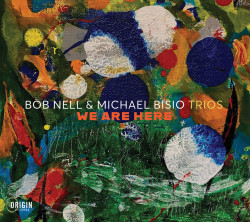
Don't be misled by the adjective naïve when describing the collaboration between pianist Bob Nell and bassist Michael Bisio. Their recording We Are Here is hardly "naïve" in the sense of being inexperienced or unsophisticated. Rather, it embodies the word's more generous meaning: music that is natural, unforced and free of affectation. There is no posturing here, only two veteran musicians trusting decades of experience and each other.
New York-born Bisio and Montana pianist Bob Nell first met in Seattle in 1975, forging a musical friendship that has endured for more than fifty years. Collectors may know them through a handful of long out-of-print recordings—Bisio's Ours (C.T. Records, 1983) and Undulations (Omnitone, 2000), or Nell's Why I Like Coffee (New World, 1992). In the liner notes to that release, pianist Wayne Horvitz observed, "Nell deserves to be a legend, in my view, because he has something one might expect to find more often, but doesn't: a style firmly rooted in the jazz tradition, yet considerably original." More than three decades later, Nell's compositions and the performances on We Are Here fully justify that assessment.
Following their early collaborations, Nell went on to perform with Eddie Harris, Freddie Hubbard, David "Fathead" Newman and Woody Shaw, while Bisio established himself as one of creative music's most distinctive bassists through collaborations with Matthew Shipp, Kirk Knuffke, Joe McPhee and many others. Their reunion finds them revisiting a dozen of Nell's compositions, joined by drummers Adam Greenberg and Austin Belluscio, who alternate throughout the album. Rather than changing the group's identity, each drummer subtly reshapes its contours, giving the music a fresh perspective from track to track.
The performances unfold with an easy confidence born of long experience. "Injury or Malpractice?" and "Blues for KB" swing with understated sophistication, the trio never rushing to make its point. "Achromaticism" playfully contradicts its title, revealing a richly colored landscape of grooves and textures. Bisio's muscular bass solo anchors the performance before giving way to an engaging dialogue between Nell's piano and Greenberg's responsive drumming.
Elsewhere, Nell demonstrates the breadth of his compositional voice. The lyrical "Elegy for Elephanthead" possesses quiet grace, while "The Bird Giant" evokes an unmistakably American folk sensibility. "Interweave" reflects the elegance and spiritual poise associated with the John Coltrane—McCoy Tyner partnership, while the delicate "Lucy's Waltz" recalls the understated lyricism of Hank Jones without ever sounding derivative. Throughout the recording, the engineering deserves special praise, allowing Bisio's resonant double bass to occupy its full acoustic space, enriching every ensemble passage.
We Are Here is less a reunion than the continuation of a conversation that began half a century ago. Nell and Bisio have little interest in dazzling listeners with virtuosity for its own sake; instead, they allow melody, swing and attentive interplay to speak for themselves. Their performances remind us that maturity in jazz often reveals itself not through complexity but through clarity, restraint and trust. Like the album's title, the music makes a simple yet profound statement of presence. After fifty years of shared history, Bob Nell and Michael Bisio remain exactly where they belong, listening deeply, creating honestly and making music that feels timeless.
New York-born Bisio and Montana pianist Bob Nell first met in Seattle in 1975, forging a musical friendship that has endured for more than fifty years. Collectors may know them through a handful of long out-of-print recordings—Bisio's Ours (C.T. Records, 1983) and Undulations (Omnitone, 2000), or Nell's Why I Like Coffee (New World, 1992). In the liner notes to that release, pianist Wayne Horvitz observed, "Nell deserves to be a legend, in my view, because he has something one might expect to find more often, but doesn't: a style firmly rooted in the jazz tradition, yet considerably original." More than three decades later, Nell's compositions and the performances on We Are Here fully justify that assessment.
Following their early collaborations, Nell went on to perform with Eddie Harris, Freddie Hubbard, David "Fathead" Newman and Woody Shaw, while Bisio established himself as one of creative music's most distinctive bassists through collaborations with Matthew Shipp, Kirk Knuffke, Joe McPhee and many others. Their reunion finds them revisiting a dozen of Nell's compositions, joined by drummers Adam Greenberg and Austin Belluscio, who alternate throughout the album. Rather than changing the group's identity, each drummer subtly reshapes its contours, giving the music a fresh perspective from track to track.
The performances unfold with an easy confidence born of long experience. "Injury or Malpractice?" and "Blues for KB" swing with understated sophistication, the trio never rushing to make its point. "Achromaticism" playfully contradicts its title, revealing a richly colored landscape of grooves and textures. Bisio's muscular bass solo anchors the performance before giving way to an engaging dialogue between Nell's piano and Greenberg's responsive drumming.
Elsewhere, Nell demonstrates the breadth of his compositional voice. The lyrical "Elegy for Elephanthead" possesses quiet grace, while "The Bird Giant" evokes an unmistakably American folk sensibility. "Interweave" reflects the elegance and spiritual poise associated with the John Coltrane—McCoy Tyner partnership, while the delicate "Lucy's Waltz" recalls the understated lyricism of Hank Jones without ever sounding derivative. Throughout the recording, the engineering deserves special praise, allowing Bisio's resonant double bass to occupy its full acoustic space, enriching every ensemble passage.
We Are Here is less a reunion than the continuation of a conversation that began half a century ago. Nell and Bisio have little interest in dazzling listeners with virtuosity for its own sake; instead, they allow melody, swing and attentive interplay to speak for themselves. Their performances remind us that maturity in jazz often reveals itself not through complexity but through clarity, restraint and trust. Like the album's title, the music makes a simple yet profound statement of presence. After fifty years of shared history, Bob Nell and Michael Bisio remain exactly where they belong, listening deeply, creating honestly and making music that feels timeless.
Soundclips
Other Reviews of
"We Are Here":
Making A Scene by Dee Dee McNeil
Bman's Blues Report by Editor
Something Else! by S. Victor Aaron
Paris Move by Thierry De Clemensat
Jazz Weekly by George W Harris