MUSIC REVIEW BY Eric Olson, The Seattle Times
Seattle jazz saxophonist makes long-awaited album debut
When saxophonist Kate Olson won the 2024 Earshot Jazz Golden Ear Award for Northwest Jazz Instrumentalist of the Year, she took to the blue-lit Royal Room stage and delivered her heartfelt thanks to a scene that, over the past 15 years, has supported her ongoing journey to the heart of improvisatory music. At 42 years old, Olson has already played her way into just about every wrinkle of PNW jazz, from funkified Nectar Lounge and straight-ahead downtown restaurant revues to the Seattle Repertory Jazz Orchestra and holiday burlesque productions. She'd been nominated for the award twice before. Third time proved the charm.
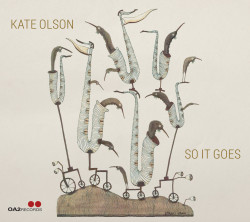
Despite her heady résumé — she's recorded on dozens of local and national projects — Olson has never dropped a full-length studio album under her own name. That changes on Jan. 16, when Origin Records releases her debut LP So It Goes, an intuitive, roomy quartet of Olson, drummer Evan Woodle, trombonist Conner Eisenmenger and bassist Tim Carey. Pianist Wayne Horvitz and bassist Geoff Harper drop by for guest spots.
The record title is an ode to Kurt Vonnegut's "Slaughterhouse-Five," specifically the Tralfamadorians, an alien species who can see across all of time and space at any given moment. Their trite response to death is, "So it goes."
The same can be said of Olson's steadfast progression into the ranks of Seattle's elite saxophonists. But a musician's path more often resembles the travails of abducted human Billy Pilgrim — caged in a Tralfamadore zoo, expected to "perform" for the public — than it does his omnipotent jailers.
Olson moved around a lot as a kid because of her father's Air Force job, settling eventually in Laramie, Wyo. "A beautiful little mountain town," she called it. "It's about 30,000 people on a good day." She found inroads to jazz where she could. But Olson's "practical" parents explained that life would almost certainly be harder if she majored in music at the nearby university.
Still, Olson couldn't shake the bug that infected her after driving two hours south to watch Chick Corea's Origin band at the Boulder Theater in Colorado. "I was in late high school," she said. "And I was just so blown away by the energy, how dynamic the band was, the communication. That was the first live performance that really got me."
Corea's Origin was a group that gave its musicians copious headspace during improvised solos. As Olson progressed into a double music major and then a master's degree at the University of Michigan, she followed in the tracks of that early spark, moving to Seattle in 2010 and joining up with experimental-leaning projects like guitarist Brian Heaney's Ask the Ages, as well as groups operating under the Monktail Creative Music Concern. She also frequented Cafe Racer's Racer Sessions, long the city's hub for avant-garde jazz with electronic elements. There, Olson met musicians like trombonist Naomi Moon Siegel, with whom she founded the "interstellar folk/punk" duo Syrinx Effect.
As a high schooler in Laramie, Olson hadn't been exposed to what a working musician's lifestyle might look like. "Living in a rural area," she said, "the thought with musicians was either you're a rock star or a starving artist." In Seattle, she strove to find the middle path. Unsurprisingly, it was a steep grade. Olson balances the books with a remarkably diverse, full-to-the-brim musical schedule. In addition to the acts mentioned above, she performs with many of Horvitz's groups — Electric Circus, Royal Room Collective Music Ensemble — Battlestar Kalakala and Birch Pereira & the Gin Joints. She teaches private lessons and is also on staff at both Pacific Lutheran University and University of Puget Sound. When she plays cabaret shows, she's frequently the musical director.
If all that weren't enough, Olson has been working on a full-length book project about the art of improvisation, which remains her guiding star as an artist. "There's a proof of concept I've been doing," she said, "teaching workshops using these methods. It's a non-music-theory approach to improvisation, the idea that you don't necessarily have to have gone through college-level theory to be a compelling improviser. Coming out of really technical programs, the improvising can feel a little soulless sometimes. The technique is potentially impressive, and all the right notes are there. But there's no sense of storytelling. There's missing lyricism and drama."
These lyrical elements are evident in Olson's own music. In 2019, she dived into her stash of jazz melodies and, operating under the name KO Ensemble, recorded "Live at the Royal Room." "But up to that point," she said, "the project was more about the body of music and less about who was in the band."
When Olson put together plans to lay down some of those same tracks in the studio — along with a batch of new ones — for her debut album, she decided on an unorthodox approach: a quartet without a chordal instrument (such as a piano or a guitar). This makes note intervals more dynamic and increases the spatial quality of the sound. "(Carey) plays a six-string bass," said Olson. "So he can fill out some chords — that's part of how he approaches the instrument. But in this setup, I'm interested in the harmony being a little freer. The soloist can go in all these directions when they're potentially playing against just a bass line."
Olson's melodies are counterbalanced with tasteful licks from trombonist Eisenmenger, a co-member in the Seattle Repertory Jazz Orchestra. "One of the reasons I wanted to work with Conner is that he himself is an incredible arranger and composer," said Olson. Woodle, meanwhile, is an old friend from the Racer Sessions — his voluminous grooves reflect that shared background.
Given Olson's experience, it's been a prolonged run to her debut album. But there are benefits that come from waiting. For one, she's enough of a known quantity to be championed by John Bishop and Origin Records, who have a national distribution network. More importantly, the first album stamped with Olson's full name represents a remarkably assured artistic vision, one that she and her bandmates can be proud of. As the aliens would say: "So it goes."
When saxophonist Kate Olson won the 2024 Earshot Jazz Golden Ear Award for Northwest Jazz Instrumentalist of the Year, she took to the blue-lit Royal Room stage and delivered her heartfelt thanks to a scene that, over the past 15 years, has supported her ongoing journey to the heart of improvisatory music. At 42 years old, Olson has already played her way into just about every wrinkle of PNW jazz, from funkified Nectar Lounge and straight-ahead downtown restaurant revues to the Seattle Repertory Jazz Orchestra and holiday burlesque productions. She'd been nominated for the award twice before. Third time proved the charm.
Despite her heady résumé — she's recorded on dozens of local and national projects — Olson has never dropped a full-length studio album under her own name. That changes on Jan. 16, when Origin Records releases her debut LP So It Goes, an intuitive, roomy quartet of Olson, drummer Evan Woodle, trombonist Conner Eisenmenger and bassist Tim Carey. Pianist Wayne Horvitz and bassist Geoff Harper drop by for guest spots.
The record title is an ode to Kurt Vonnegut's "Slaughterhouse-Five," specifically the Tralfamadorians, an alien species who can see across all of time and space at any given moment. Their trite response to death is, "So it goes."
The same can be said of Olson's steadfast progression into the ranks of Seattle's elite saxophonists. But a musician's path more often resembles the travails of abducted human Billy Pilgrim — caged in a Tralfamadore zoo, expected to "perform" for the public — than it does his omnipotent jailers.
Olson moved around a lot as a kid because of her father's Air Force job, settling eventually in Laramie, Wyo. "A beautiful little mountain town," she called it. "It's about 30,000 people on a good day." She found inroads to jazz where she could. But Olson's "practical" parents explained that life would almost certainly be harder if she majored in music at the nearby university.
Still, Olson couldn't shake the bug that infected her after driving two hours south to watch Chick Corea's Origin band at the Boulder Theater in Colorado. "I was in late high school," she said. "And I was just so blown away by the energy, how dynamic the band was, the communication. That was the first live performance that really got me."
Corea's Origin was a group that gave its musicians copious headspace during improvised solos. As Olson progressed into a double music major and then a master's degree at the University of Michigan, she followed in the tracks of that early spark, moving to Seattle in 2010 and joining up with experimental-leaning projects like guitarist Brian Heaney's Ask the Ages, as well as groups operating under the Monktail Creative Music Concern. She also frequented Cafe Racer's Racer Sessions, long the city's hub for avant-garde jazz with electronic elements. There, Olson met musicians like trombonist Naomi Moon Siegel, with whom she founded the "interstellar folk/punk" duo Syrinx Effect.
As a high schooler in Laramie, Olson hadn't been exposed to what a working musician's lifestyle might look like. "Living in a rural area," she said, "the thought with musicians was either you're a rock star or a starving artist." In Seattle, she strove to find the middle path. Unsurprisingly, it was a steep grade. Olson balances the books with a remarkably diverse, full-to-the-brim musical schedule. In addition to the acts mentioned above, she performs with many of Horvitz's groups — Electric Circus, Royal Room Collective Music Ensemble — Battlestar Kalakala and Birch Pereira & the Gin Joints. She teaches private lessons and is also on staff at both Pacific Lutheran University and University of Puget Sound. When she plays cabaret shows, she's frequently the musical director.
If all that weren't enough, Olson has been working on a full-length book project about the art of improvisation, which remains her guiding star as an artist. "There's a proof of concept I've been doing," she said, "teaching workshops using these methods. It's a non-music-theory approach to improvisation, the idea that you don't necessarily have to have gone through college-level theory to be a compelling improviser. Coming out of really technical programs, the improvising can feel a little soulless sometimes. The technique is potentially impressive, and all the right notes are there. But there's no sense of storytelling. There's missing lyricism and drama."
These lyrical elements are evident in Olson's own music. In 2019, she dived into her stash of jazz melodies and, operating under the name KO Ensemble, recorded "Live at the Royal Room." "But up to that point," she said, "the project was more about the body of music and less about who was in the band."
When Olson put together plans to lay down some of those same tracks in the studio — along with a batch of new ones — for her debut album, she decided on an unorthodox approach: a quartet without a chordal instrument (such as a piano or a guitar). This makes note intervals more dynamic and increases the spatial quality of the sound. "(Carey) plays a six-string bass," said Olson. "So he can fill out some chords — that's part of how he approaches the instrument. But in this setup, I'm interested in the harmony being a little freer. The soloist can go in all these directions when they're potentially playing against just a bass line."
Olson's melodies are counterbalanced with tasteful licks from trombonist Eisenmenger, a co-member in the Seattle Repertory Jazz Orchestra. "One of the reasons I wanted to work with Conner is that he himself is an incredible arranger and composer," said Olson. Woodle, meanwhile, is an old friend from the Racer Sessions — his voluminous grooves reflect that shared background.
Given Olson's experience, it's been a prolonged run to her debut album. But there are benefits that come from waiting. For one, she's enough of a known quantity to be championed by John Bishop and Origin Records, who have a national distribution network. More importantly, the first album stamped with Olson's full name represents a remarkably assured artistic vision, one that she and her bandmates can be proud of. As the aliens would say: "So it goes."
Soundclips
Other Reviews of
"So It Goes":
Women in Jazz Magazine by Editor
Exposé Online by Jon Davis
Take Effect by Tom Haugen
Step Tempest by Richard Kamins
Earshot Jazz by Nathan Bluford
Modern Drummer by Editor
The Stranger by Dave Segal
Bman's Blues Report by Editor
Making A Scene by Dee Dee McNeil
Jazz Weekly by George Harris
Paris-Move by Thierry De Clemensat