MUSIC REVIEW BY Dan McClenaghan, All About Jazz
4-STARS At the time of this writing (early 2026), the United States is beset by an odious president, a racist sociopath who seems hellbent on erasing all references to achievement or success of anyone of African descent—leaving aside that we are all of African descent; but some made the relocation to North America involuntarily.
Stubborn resistance and unvarnished artistic statement—shoulders pulled back, chins jutting forward—are tools to fight the evil fool(s), and Anthony Branker does his part. Uppity (2013), What A Place Can Be (2023) and The Forward (Toward Equality) Suite—all on Origin Records—all address racism, exploitation, intolerance and hatred pointed at those of African descent. Pointed at anyone with brown skin, for that matter.
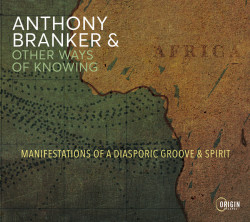
Branker's work, especially on the three cited albums, and on the one at hand, Manifestations of a Diasporic Groove pushes against the white supremacist mindset with sharply-crafted, often fierce-minded and life-affirming compositions in the hands of his sextet, Other Ways Of Knowing.
Branker draws inspiration from socio-historic events of the African and Indigenous diaspora for four of the seven compositions included here. "Freedom Water March (At IGBO) Landing)" addresses an early 19th-century arrival to the New World of a group of 75 Igbo people (from modern-day Nigeria) who mutinied on the slave ship that brought them to America. They drowned their captors. Once ashore, the 75 people, still in chains, walked into a marsh, chanting and singing songs of their homeland, and committed a mass suicide. The tune opens on Simona Premazzi's mournful piano that lays a foundation for Pete McCann's piquant electric guitar lines. The sounds glow with a striking and beautiful melancholy. Bassist John Hébert and drummer Rudy Royston bustle forward, into the marsh.
On the disc's opener "The Children Of Lyles Station," alto saxophonist Steve Wilson blows with a sense of stinging outrage, at (almost certainly) the plight of stinging outrage at 1927 event that has passed under the awareness of even many socially aware folks: the contemptable bait and switch that sent 10 African American children to, instead of a ringworm treatment, to experiments with high dosage radiation. This without parental consent. Radiation dosages that resulted in disfiguring scars, malformed skulls and lifelong pain. This is what America gives to those deemed less than human. Branker's channeled indignance, and his group's near-mutinous eloquence, interspersed with moments of deep despondence that re-gathers in the direction of outrage, captures this atrocity in a stark light.
The themes are weighty and serious; the music is captivatingly complex—all of it composed by Branker. Arrangements do not follow any template, and the players—including vocalist Aimée Allen, who sits here and there with some gorgeous vocalese—ride the wave of the diaspora, the groove and the spirit.
How 'bout that, Mr. President?
Stubborn resistance and unvarnished artistic statement—shoulders pulled back, chins jutting forward—are tools to fight the evil fool(s), and Anthony Branker does his part. Uppity (2013), What A Place Can Be (2023) and The Forward (Toward Equality) Suite—all on Origin Records—all address racism, exploitation, intolerance and hatred pointed at those of African descent. Pointed at anyone with brown skin, for that matter.
Branker's work, especially on the three cited albums, and on the one at hand, Manifestations of a Diasporic Groove pushes against the white supremacist mindset with sharply-crafted, often fierce-minded and life-affirming compositions in the hands of his sextet, Other Ways Of Knowing.
Branker draws inspiration from socio-historic events of the African and Indigenous diaspora for four of the seven compositions included here. "Freedom Water March (At IGBO) Landing)" addresses an early 19th-century arrival to the New World of a group of 75 Igbo people (from modern-day Nigeria) who mutinied on the slave ship that brought them to America. They drowned their captors. Once ashore, the 75 people, still in chains, walked into a marsh, chanting and singing songs of their homeland, and committed a mass suicide. The tune opens on Simona Premazzi's mournful piano that lays a foundation for Pete McCann's piquant electric guitar lines. The sounds glow with a striking and beautiful melancholy. Bassist John Hébert and drummer Rudy Royston bustle forward, into the marsh.
On the disc's opener "The Children Of Lyles Station," alto saxophonist Steve Wilson blows with a sense of stinging outrage, at (almost certainly) the plight of stinging outrage at 1927 event that has passed under the awareness of even many socially aware folks: the contemptable bait and switch that sent 10 African American children to, instead of a ringworm treatment, to experiments with high dosage radiation. This without parental consent. Radiation dosages that resulted in disfiguring scars, malformed skulls and lifelong pain. This is what America gives to those deemed less than human. Branker's channeled indignance, and his group's near-mutinous eloquence, interspersed with moments of deep despondence that re-gathers in the direction of outrage, captures this atrocity in a stark light.
The themes are weighty and serious; the music is captivatingly complex—all of it composed by Branker. Arrangements do not follow any template, and the players—including vocalist Aimée Allen, who sits here and there with some gorgeous vocalese—ride the wave of the diaspora, the groove and the spirit.
How 'bout that, Mr. President?
Soundclips
Other Reviews of
"Manifestations of a Diasporic Groove & Spirit":
Take Effect by Tom Haugen
Modern Drummer by Editor
Jazz Weekly by George W Harris
Jazz Blues European Union by Olivia Peevas
Paris Move by Thierry De Clemensat
Jazz Blues European Union (Interview) by Olivia Peevas