MUSIC REVIEW BY Ferdinand DuPuis-Panther, Jazz'Halo (Belgium)
To the album we read: "With HOMETOWN, trumpeter and composer Jared Hall brings listeners into a musically rich reflection on place, purpose, and artistic growth. Born in Spokane and seasoned by vibrant creative communities from Bloomington to Miami and Seattle, Hall returns to his roots with a lyrical voice shaped by decades of performance and collaboration. Here, he celebrates the grounding power of family, shared history, and the joy of reconnecting with the people and experiences that shaped him."
Jared Hall's quintet consists of saxophonist Troy Roberts, pianist Ben Markley, bassist Michael Glynn and drummer Kyle Swan.
The title song "Hometown" opens the album. To a distinct piano setting that is reminiscent of funk, the two horns then rise with full power and verve. We hear soloists in the further course. The trumpeter blows wavy lines in his solo. The saxophonist can be heard in a similar style, sonorous and exhausting the tonal range of his tenor saxophone. In addition, one hears a plong-plong of the pianist as an accompanying note, before the two winds reunite in the theme at the end. It continues with "Step by Step": the piece is fast-paced and moved in style. Certainly the trumpeter has the "say", but ... . At times, Jared Hall acts lyrically and with swing. Euphony and the melodic are important to him. The pianist and drummer provide the rhythmic underpinnings. As a listener, you sometimes have the impression that you are musically experiencing a painting of an impressionist spring landscape, whether by Pissarro or Cezanne. The pianist plays as if he were tracing a stream in chords. The saxophonist acts brightly, but in contrast to the notorious market clamor of a saxophone, he does without it and rather delivers soft focus. A musical treat is the duet of the two wind players, which makes up an essential part of the piece.
Bobby Hutcherson wrote "Little B's Poem", which Jared Hall and his fellow musicians interpreted. Ballad or Broadway song - that's what you ask yourself when listening. Oh, sometimes the bass player comes to the fore and plays a solo, accompanied by the pianist and drummer. However, the sound of the double bass is not sustainable, especially not when you think of the presence of the winds. Klangwolke nestles next to Klangwolke, also thanks to Jared Hall and his convincing trumpet playing. As a soloist, Hall also provides a feast for the ears.
It continues with "Echoes and Origins" and also in this piece the focus is on the trumpeter, who draws the lines of the melody. No less important is the pianist's keyboard playing in his phrasing, which is reminiscent of sea rumblings and waves. It is the winds who define the colorations of the piece and also shape the echoes. Towards the end of the piece, the creative power of the drummer is also revealed, who is given space for free development. After "Family Groove" follows Monk's composition "Ask Me Now": If you know the original, you will quickly realize that Jared Hall and his fellow musicians behave quite faithfully to the work. However, it must be noted that the piano plays the main role in Monk's work and not a brass player. Listen to the first recording from July 23, 1951!
The play "Room 111" gets down to business at a fast pace. At the same time, listening to it, one has the impression that the jazz of the 1950s and 1960s is experiencing its resurrection. With a repetition or variation of "Hometown" closes the very successful album, which comes along in the spirit of post-bop and modern jazz.
Translated from German
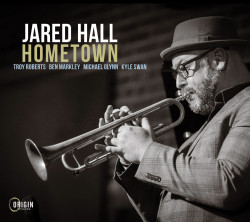
Jared Hall's quintet consists of saxophonist Troy Roberts, pianist Ben Markley, bassist Michael Glynn and drummer Kyle Swan.
The title song "Hometown" opens the album. To a distinct piano setting that is reminiscent of funk, the two horns then rise with full power and verve. We hear soloists in the further course. The trumpeter blows wavy lines in his solo. The saxophonist can be heard in a similar style, sonorous and exhausting the tonal range of his tenor saxophone. In addition, one hears a plong-plong of the pianist as an accompanying note, before the two winds reunite in the theme at the end. It continues with "Step by Step": the piece is fast-paced and moved in style. Certainly the trumpeter has the "say", but ... . At times, Jared Hall acts lyrically and with swing. Euphony and the melodic are important to him. The pianist and drummer provide the rhythmic underpinnings. As a listener, you sometimes have the impression that you are musically experiencing a painting of an impressionist spring landscape, whether by Pissarro or Cezanne. The pianist plays as if he were tracing a stream in chords. The saxophonist acts brightly, but in contrast to the notorious market clamor of a saxophone, he does without it and rather delivers soft focus. A musical treat is the duet of the two wind players, which makes up an essential part of the piece.
Bobby Hutcherson wrote "Little B's Poem", which Jared Hall and his fellow musicians interpreted. Ballad or Broadway song - that's what you ask yourself when listening. Oh, sometimes the bass player comes to the fore and plays a solo, accompanied by the pianist and drummer. However, the sound of the double bass is not sustainable, especially not when you think of the presence of the winds. Klangwolke nestles next to Klangwolke, also thanks to Jared Hall and his convincing trumpet playing. As a soloist, Hall also provides a feast for the ears.
It continues with "Echoes and Origins" and also in this piece the focus is on the trumpeter, who draws the lines of the melody. No less important is the pianist's keyboard playing in his phrasing, which is reminiscent of sea rumblings and waves. It is the winds who define the colorations of the piece and also shape the echoes. Towards the end of the piece, the creative power of the drummer is also revealed, who is given space for free development. After "Family Groove" follows Monk's composition "Ask Me Now": If you know the original, you will quickly realize that Jared Hall and his fellow musicians behave quite faithfully to the work. However, it must be noted that the piano plays the main role in Monk's work and not a brass player. Listen to the first recording from July 23, 1951!
The play "Room 111" gets down to business at a fast pace. At the same time, listening to it, one has the impression that the jazz of the 1950s and 1960s is experiencing its resurrection. With a repetition or variation of "Hometown" closes the very successful album, which comes along in the spirit of post-bop and modern jazz.
Translated from German
Soundclips
Other Reviews of
"Hometown":
Take Effect by Tom Haugen
Modern Drummer by Editor
DownBeat by Paul de Barros
Bman's Blues Report by Editor
Making A Scene by Dee Dee McNeil
All About Jazz by Jack Bowers
Los Angeles Jazz Scene by Scott Yanow
UK Vibe by Mike Gates
Jazz Weekly by George Harris
Paris-Move by Thierry de Clemensat