MUSIC REVIEW BY Thierry de Clemensat, Paris-Move
5 STARS
Hometown - Jared Hall's Intimate Cartography of Sound
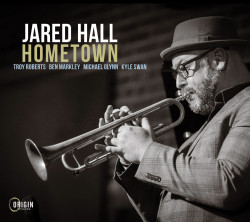
A monochrome album cover sets the tone: understated, almost austere, yet quietly evocative. From the very first notes, the trumpet enters not as a declaration but as an invitation, its sound warm, deliberate, and imbued with a sense of modernity that feels rooted as much in ideas as in tone. It is the kind of opening that lends itself perfectly to the early hours of the day, when attention is sharp and the world still feels open.
With Hometown, trumpeter Jared Hall delivers a work of striking coherence and depth. Surrounded by a superb quintet, including the exceptional saxophonist Troy Roberts, Hall presents a collection of eight compositions that bridge past and present with remarkable fluidity. The acoustic setting reinforces this dialogue across eras, allowing each instrument to breathe within a shared, carefully balanced space.
Hall's résumé is, by any measure, formidable. His collaborations span an impressive spectrum of contemporary jazz, including work alongside Paquito D'Rivera, Maria Schneider, Arturo Sandoval, Dave Liebman, Terence Blanchard, and George Benson, among many others. Yet Hometown resists any temptation to rely on pedigree. Instead, it feels deeply personal, a return not only to geographical origins but to formative emotional landscapes.
Born in Spokane and shaped by the vibrant creative communities of Bloomington, Miami, and Seattle, Hall reconnects here with his roots. The album unfolds as a meditation on belonging: the quiet pull of family, the imprint of shared histories, and the enduring resonance of lived experience. These themes are not spelled out; they emerge organically through the music's lyrical clarity and emotional restraint.
What makes Hometown particularly compelling is its ability to reconcile complexity with accessibility. Hall's compositions are structurally sophisticated, marked by subtle harmonic turns, dynamic rhythmic interplay, and carefully shaped melodic lines, yet they remain immediately engaging. There is no sense of distance or abstraction; instead, the listener is drawn in, almost effortlessly, into a sound world that feels both intimate and expansive.
Of the eight tracks, only two are drawn from external sources: one by Bobby Hutcherson and another by Thelonious Monk. These inclusions are not mere nods to tradition but serve as points of dialogue. Hall reinterprets them with a refined sensibility, integrating them seamlessly into the album's broader aesthetic. His influences are wide-ranging, and at moments one might detect echoes of Chick Corea or Miles Davis. Yet these resonances never overshadow his own voice. Hall's writing is distinctive, an equilibrium between rhythm and melody that feels both deliberate and organic.
Such compositional balance demands musicians capable of nuance and responsiveness, and this quintet delivers precisely that. The interplay is fluid, attentive, and deeply collaborative. Rather than showcasing individual virtuosity in isolation, the ensemble operates as a unified organism, each member shaping the music in real time. This collective sensitivity gives the album much of its emotional weight.
Melodically, Hall occasionally draws from a post-bop vocabulary reminiscent of the 1950s, evoking something akin to a nostalgic family portrait, warm, textured, and alive with memory. Yet this backward glance is never static. It functions instead as a springboard into a contemporary language, where tradition is not preserved but reimagined. The result is music that feels timeless without ever becoming retrospective.
Across its eight tracks, Hometown unfolds with remarkable cohesion. The album's pacing is so natural, its atmosphere so immersive, that it seems to pass almost too quickly, a telling sign of its overall strength. There is a subtle but persistent sense of place throughout: a blend of dream, memory, and reflection that transforms listening into an experience of return. One finds oneself replaying the album almost unconsciously, drawn back into what feels like an auditory home.
There is, inevitably, a sense of missed presence, the feeling that witnessing these sessions in person would have offered yet another layer of insight. Each musician contributes ideas that are both inventive and perfectly attuned to the material, reinforcing the impression of a deeply engaged, living performance.
Ultimately, Hometown is not an album that seeks to impress through overt display. Its power lies in its restraint, its clarity of vision, and the depth of its musical intelligence. The arrangements are finely crafted, the performances consistently elevated, and the overall result is one of quiet but lasting impact.
With repeated listening, new details emerge. In particular, the contribution of bassist Michael Glynn proves quietly essential. His playing, supple, precise, and deeply grounded, anchors the ensemble while allowing the music to remain fluid. It is a role of subtle authority, and one he fulfills with remarkable finesse.
In the end, Hometown stands as a work of rare balance: personal yet universal, rooted yet forward-looking. It is less a statement than a space, one that invites the listener not simply to hear, but to return.
Hometown - Jared Hall's Intimate Cartography of Sound
A monochrome album cover sets the tone: understated, almost austere, yet quietly evocative. From the very first notes, the trumpet enters not as a declaration but as an invitation, its sound warm, deliberate, and imbued with a sense of modernity that feels rooted as much in ideas as in tone. It is the kind of opening that lends itself perfectly to the early hours of the day, when attention is sharp and the world still feels open.
With Hometown, trumpeter Jared Hall delivers a work of striking coherence and depth. Surrounded by a superb quintet, including the exceptional saxophonist Troy Roberts, Hall presents a collection of eight compositions that bridge past and present with remarkable fluidity. The acoustic setting reinforces this dialogue across eras, allowing each instrument to breathe within a shared, carefully balanced space.
Hall's résumé is, by any measure, formidable. His collaborations span an impressive spectrum of contemporary jazz, including work alongside Paquito D'Rivera, Maria Schneider, Arturo Sandoval, Dave Liebman, Terence Blanchard, and George Benson, among many others. Yet Hometown resists any temptation to rely on pedigree. Instead, it feels deeply personal, a return not only to geographical origins but to formative emotional landscapes.
Born in Spokane and shaped by the vibrant creative communities of Bloomington, Miami, and Seattle, Hall reconnects here with his roots. The album unfolds as a meditation on belonging: the quiet pull of family, the imprint of shared histories, and the enduring resonance of lived experience. These themes are not spelled out; they emerge organically through the music's lyrical clarity and emotional restraint.
What makes Hometown particularly compelling is its ability to reconcile complexity with accessibility. Hall's compositions are structurally sophisticated, marked by subtle harmonic turns, dynamic rhythmic interplay, and carefully shaped melodic lines, yet they remain immediately engaging. There is no sense of distance or abstraction; instead, the listener is drawn in, almost effortlessly, into a sound world that feels both intimate and expansive.
Of the eight tracks, only two are drawn from external sources: one by Bobby Hutcherson and another by Thelonious Monk. These inclusions are not mere nods to tradition but serve as points of dialogue. Hall reinterprets them with a refined sensibility, integrating them seamlessly into the album's broader aesthetic. His influences are wide-ranging, and at moments one might detect echoes of Chick Corea or Miles Davis. Yet these resonances never overshadow his own voice. Hall's writing is distinctive, an equilibrium between rhythm and melody that feels both deliberate and organic.
Such compositional balance demands musicians capable of nuance and responsiveness, and this quintet delivers precisely that. The interplay is fluid, attentive, and deeply collaborative. Rather than showcasing individual virtuosity in isolation, the ensemble operates as a unified organism, each member shaping the music in real time. This collective sensitivity gives the album much of its emotional weight.
Melodically, Hall occasionally draws from a post-bop vocabulary reminiscent of the 1950s, evoking something akin to a nostalgic family portrait, warm, textured, and alive with memory. Yet this backward glance is never static. It functions instead as a springboard into a contemporary language, where tradition is not preserved but reimagined. The result is music that feels timeless without ever becoming retrospective.
Across its eight tracks, Hometown unfolds with remarkable cohesion. The album's pacing is so natural, its atmosphere so immersive, that it seems to pass almost too quickly, a telling sign of its overall strength. There is a subtle but persistent sense of place throughout: a blend of dream, memory, and reflection that transforms listening into an experience of return. One finds oneself replaying the album almost unconsciously, drawn back into what feels like an auditory home.
There is, inevitably, a sense of missed presence, the feeling that witnessing these sessions in person would have offered yet another layer of insight. Each musician contributes ideas that are both inventive and perfectly attuned to the material, reinforcing the impression of a deeply engaged, living performance.
Ultimately, Hometown is not an album that seeks to impress through overt display. Its power lies in its restraint, its clarity of vision, and the depth of its musical intelligence. The arrangements are finely crafted, the performances consistently elevated, and the overall result is one of quiet but lasting impact.
With repeated listening, new details emerge. In particular, the contribution of bassist Michael Glynn proves quietly essential. His playing, supple, precise, and deeply grounded, anchors the ensemble while allowing the music to remain fluid. It is a role of subtle authority, and one he fulfills with remarkable finesse.
In the end, Hometown stands as a work of rare balance: personal yet universal, rooted yet forward-looking. It is less a statement than a space, one that invites the listener not simply to hear, but to return.
Soundclips
Other Reviews of
"Hometown":
Take Effect by Tom Haugen
Modern Drummer by Editor
DownBeat by Paul de Barros
Bman's Blues Report by Editor
Making A Scene by Dee Dee McNeil
All About Jazz by Jack Bowers
Los Angeles Jazz Scene by Scott Yanow
UK Vibe by Mike Gates
Jazz'Halo (Belgium) by Ferdinand DuPuis-Panther
Jazz Weekly by George Harris