MUSIC REVIEW BY Dee Dee McNeil, Making A Scene
Gabriel Espinosa is a bassist and composer who fell in love with the Brazilian music of the 1960s. Espinosa was raised in Mexico on boleros and music of the pop/rock sensation, like The Beatles. But it was the hypnotic music of bossa nova that directed his artistic path to Berklee College of Music, then North Texas State, and onto Iowa, where Gabriel finally settled.
For this, his eighth album release, Gabriel Espinosa has set aside his bass instrument and focuses all his attention on his original compositions and Brazilian arrangements. Recorded in Rio de Janeiro and enhanced by the Tallinn Studio Orchestra, the album opens with Espinosa's original composition, "Gabriela." It's an homage to his wife of forty-two years. It's a pretty bossa nova tune that's played at a moderate pace with a Latin-feel injected on the fade of the tune. The orchestrated horns carry the melody along with very harmonic lines.
"I had always dreamed of recording my compositions with a small, big band made up entirely of Brazilian musicians, as I believe they bring a uniquely special feeling to interpreting and arranging music. I was fortunate to connect with Rafael Rocha and Bruno Santos, who were willing to arrange my pieces and record them in Brazil with an incredible group of musicians. ... It was a magical collaboration," Gabriel Espinosa wrote in his liner notes.
"Caramelo" was written for his second daughter who he thinks is as sweet a caramel candy. Bruno Santos plays a beautiful flugelhorn solo on this tune. This composition is followed by a lovely Bolero ballad called "Fe" composed for his second daughter, Adriana.
A Jerana is a typical dance from Espinosa's hometown of Yucatan, Mexico, written in 6/8 time. "Mi Jarana" features Josue Lopez on tenor saxophone and the piano of Felipe Silveira, who interjects a tiny taste of the blues into his piano solo. "Klavier Latino" features Joabe Reis on trombone and a stunning saxophone solo by Josue Lopez.
Most of the Gabriel Espinosa tunes are arranged in a very easy listening Brazilian way. The songs are cross-cultural, embodying his rich Mexican heritage with the wonderful culture of Brazil that Espinosa so admires. This album offers a fresh, contemporary voice celebrating Latin music. Perhaps Espinosa explained it best when he said, "Bossa nova literally means "new tendency" or "new thing."
This is Gabriel Espinosa's "new thing," an album that's celebrated as "The Brazilian Project" boldly featuring all of his original compositions.
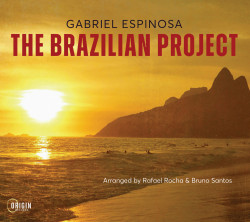
For this, his eighth album release, Gabriel Espinosa has set aside his bass instrument and focuses all his attention on his original compositions and Brazilian arrangements. Recorded in Rio de Janeiro and enhanced by the Tallinn Studio Orchestra, the album opens with Espinosa's original composition, "Gabriela." It's an homage to his wife of forty-two years. It's a pretty bossa nova tune that's played at a moderate pace with a Latin-feel injected on the fade of the tune. The orchestrated horns carry the melody along with very harmonic lines.
"I had always dreamed of recording my compositions with a small, big band made up entirely of Brazilian musicians, as I believe they bring a uniquely special feeling to interpreting and arranging music. I was fortunate to connect with Rafael Rocha and Bruno Santos, who were willing to arrange my pieces and record them in Brazil with an incredible group of musicians. ... It was a magical collaboration," Gabriel Espinosa wrote in his liner notes.
"Caramelo" was written for his second daughter who he thinks is as sweet a caramel candy. Bruno Santos plays a beautiful flugelhorn solo on this tune. This composition is followed by a lovely Bolero ballad called "Fe" composed for his second daughter, Adriana.
A Jerana is a typical dance from Espinosa's hometown of Yucatan, Mexico, written in 6/8 time. "Mi Jarana" features Josue Lopez on tenor saxophone and the piano of Felipe Silveira, who interjects a tiny taste of the blues into his piano solo. "Klavier Latino" features Joabe Reis on trombone and a stunning saxophone solo by Josue Lopez.
Most of the Gabriel Espinosa tunes are arranged in a very easy listening Brazilian way. The songs are cross-cultural, embodying his rich Mexican heritage with the wonderful culture of Brazil that Espinosa so admires. This album offers a fresh, contemporary voice celebrating Latin music. Perhaps Espinosa explained it best when he said, "Bossa nova literally means "new tendency" or "new thing."
This is Gabriel Espinosa's "new thing," an album that's celebrated as "The Brazilian Project" boldly featuring all of his original compositions.
Soundclips
Other Reviews of
"The Brazilian Project":
Milenio Arte (Mexico City) by Xavier Quirarte
Jazziz by Editor
Take Effect by Tom Haugen
Amazon by Dr. Debra Jan Bibel
El Heraldo de Mexico by Pablo Iván Argüello
Lemon Wire by Navya Dixit
Modern Drummer by Editor
Jazz Weekly by George W. Harris
Paris Move by Thierry De Clemensat