MUSIC REVIEW BY Thierry De Clemensat, Paris Move
*Indispensible* Michael Brecker's Legacy: When Tribute Must Become Music
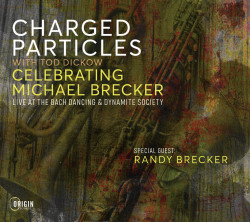
Paying tribute to Michael Brecker, who died in 2007, means more than bringing back a body of work whose virtuosity continues to astonish. The deeper purpose is to reconnect with the creative tension behind the demanding compositions and formidable instrumental technique that helped make Brecker a defining figure in modern jazz. His music was never simply a display of technical command; its lasting power lay in the restless imagination that animated every phrase. With Celebrating Michael Brecker: Live at the Bach Dancing & Dynamite Society, Charged Particles takes up that challenge in a concert recorded Aug. 3, 2025, in Half Moon Bay, California, at the conclusion of a regional tour. The presence of Randy Brecker, Michael's older brother and a longtime collaborator across several musical ventures, gives the project a distinctive personal and historical resonance. Yet the significance of this reunion rests on more than family ties. The album succeeds because it approaches an established repertoire as living music, allowing listeners to hear familiar compositions through the sensibilities of musicians who have spent years engaging with their possibilities.
The program brings together seven compositions across a little more than 71 minutes. Four were written by Michael Brecker: "Madame Toulouse," "When Can I Kiss You Again?," "Loose Threads" and "Pilgrimage." Two others, "El Niño" and "Midnight Voyage," were composed by Joey Calderazzo, the pianist who developed an important musical relationship with Brecker. The seventh piece, Hal Galper's "Triple Play," broadens the picture further. This is more than a collection of signature tunes assembled to celebrate a celebrated saxophonist. Taken together, the selections illuminate the musical environment in which Brecker developed his distinctive language, with its sophisticated harmonic structures, intricate rhythms and fluid movement between modern jazz, electric energy and chamber-like precision. Calderazzo's presence is particularly revealing. It underscores the extent to which Brecker's musical imagination was shaped through sustained exchanges with composers and instrumentalists who challenged him to explore unfamiliar territory. Charged Particles approaches this repertoire with a clear sense of that collaborative history, bringing its own collective identity to compositions that reward both technical precision and interpretive imagination.
Opening with Brecker's "Madame Toulouse" establishes the album's musical vocabulary at once. The selection is more than a statement of purpose or a convenient introduction to the saxophonist's legacy. It establishes a dialogue between a recognizable compositional voice and the personalities of the musicians now interpreting it. For the group, the piece offers an opportunity to demonstrate how deeply it has absorbed Brecker's musical language while allowing that language to retain its capacity for surprise. The challenge is especially evident in the tenor saxophone playing of Tod Dickow. Brecker's signature sound was distinguished by exacting articulation, an extraordinary ability to navigate densely constructed phrases without sacrificing continuity, and a gift for turning technical difficulty into forward momentum. His approach set a formidable standard, but it also demonstrated how technique could serve a larger expressive purpose. Dickow's interpretation draws its strength from engaging with that demanding vocabulary on its own terms while allowing the music to breathe through his individual phrasing. The result reinforces a central principle of jazz interpretation: fidelity is most meaningful when it illuminates the character of a composition rather than merely reproducing the surface features of a familiar performance.
That principle informs the work of the entire quintet. Charged Particles brings together pianist Murray Low, bassist Aaron Germain and drummer Jon Krosnick, alongside Dickow on tenor saxophone and Randy Brecker on trumpet. Founded as a trio in 1993, the group assumed its current configuration in 2015 with Dickow's arrival. That history matters. This is not an ensemble hastily assembled around a prestigious guest and a ready-made repertoire. The musicians share a collective identity, years of experience and a sustained engagement with fusion that enables them to approach demanding arrangements without reducing them to exercises in instrumental technique. Their strength lies in the relationship between compositional discipline and the flexibility of live performance. In music of this complexity, that balance is essential. The written structures provide direction, while improvisation allows the players to discover new possibilities within them. Charged Particles understands that these elements are complementary rather than competing forces. The ensemble's cohesion gives the soloists room to explore, and its rhythmic foundation keeps the music moving without constraining its expressive range.
Randy Brecker's participation is one of the album's defining features, not simply because of his relationship to Michael but because of the musical perspective he brings to the ensemble. His appearance is not a ceremonial gesture intended to lend historical legitimacy to the occasion. Since the 1970s, Brecker has helped expand the boundaries between jazz, funk, rock and popular music, most notably through the Brecker Brothers. His musical partnership with Michael reflected a shared determination to take jazz into new territory, combining harmonic sophistication with a direct, physical rhythmic drive. Randy's trumpet therefore contributes more than a family connection. It evokes a broader history of electric jazz, a period when musicians sought to reach wider audiences without compromising the complexity of their musical ideas. His presence also brings an additional dimension to the arrangements, enriching the dialogue between the soloists and adding a distinctive tonal color to the ensemble. The historical resonance of the occasion is inseparable from the music itself, but it is the interaction among the players that ultimately gives the reunion its artistic substance.
The sequence of compositions reveals the breadth of the material. After "Madame Toulouse," Calderazzo's "El Niño" shifts the program's center of gravity. Its inclusion reminds us that the musical language associated with Michael Brecker extended well beyond his own compositions. He developed it through encounters with musicians whose writing demanded rhythmic invention, harmonic mobility and an expansive approach to improvisation. The two Calderazzo pieces consequently offer a valuable perspective on Brecker as a participant in a larger creative community rather than an isolated musical innovator. They also give Charged Particles an opportunity to demonstrate the strength of its own instrumental relationships. Low's piano, Germain's bass and Krosnick's drums provide far more than accompaniment for the two featured soloists. They establish the foundation from which the music gathers momentum, changes direction and finds moments of repose. In a repertoire where melodic lines can be exceptionally dense, the clarity of that foundation is crucial. Virtuosity achieves its fullest expression when the architecture supporting it remains audible, allowing individual flights of imagination to contribute to a coherent musical narrative.
"When Can I Kiss You Again?" returns the program to Brecker's own writing, bringing a more intimate dimension to the repertoire. Its questioning title suggests that a composition's expressive character cannot be measured solely by its technical demands. Beneath the intricate structures and expansive opportunities for improvisation lies a melodic intention, an atmosphere and a particular way of shaping musical time. This is one of the essential distinctions in virtuoso music: the abundance of notes matters because of the ideas they convey, not simply because of the dexterity required to play them. The composition's identity resides in the relationship between its melodic contours, harmonic movement and expressive inflections. For interpreters, the task is to preserve those defining qualities while allowing the music to develop naturally in performance. Charged Particles approaches the piece with an understanding that technical command and melodic sensitivity are not separate achievements. The former serves the latter, giving the music room to unfold without obscuring the character that makes it distinctive.
Hal Galper's "Triple Play" takes the album beyond Brecker's own repertoire once again. At 11 minutes and one second, it ranks among the program's more extended performances, alongside "Midnight Voyage," "Loose Threads" and "Pilgrimage." These longer pieces give the musicians additional room to develop their ideas and establish a sense of musical progression. Their value lies not in duration alone but in the opportunities that extended improvisation creates for transformation. A musical idea can be expanded, redirected, challenged and eventually understood in a different light. Galper's composition contributes to that broader exploration, shifting attention from the question of fidelity to Brecker's repertoire toward the ensemble's ability to inhabit a demanding musical language on its own terms. Charged Particles uses the variety of the program to emphasize that a jazz tradition remains vital through continued engagement, not through preservation alone. The musicians' technical resources are considerable, but what matters most is how those resources serve the evolving conversation among the instruments.
Calderazzo's "Midnight Voyage" extends that sense of exploration. Its title suggests movement and discovery, but its significance also lies in its place within the program. The piece reinforces the idea that Brecker's legacy cannot be reduced to a collection of compositions whose original forms must remain untouched. It also encompasses a way of playing, an approach to risk and a conception of improvisation as an act of construction. Musicians working within this tradition are invited to uncover possibilities that may not have been fully realized in earlier performances. The repertoire becomes a meeting ground between what has been written and what can emerge in the moment. That process depends on active listening, so that individual contributions become part of a shared musical direction rather than a succession of disconnected statements. A successful fusion ensemble is defined not only by the precision of its entrances or the complexity of its rhythmic patterns but also by its ability to maintain a collective purpose as the instruments move through contrasting textures and ideas. Charged Particles' long-standing familiarity with this material gives that exchange a natural foundation.
"Loose Threads," which runs for more than 12 minutes and is the album's longest track, offers a particularly revealing example of the relationship between compositional design and sustained improvisation. An extended performance asks musicians to maintain intensity while allowing the music to evolve, to explore new directions without losing sight of the original theme, and to give individual solos room to develop within a larger formal structure. These concerns are central to the electric jazz tradition that flourished in the 1970s and 1980s, in which Michael Brecker played a major role. That music is sometimes remembered primarily for its power and instrumental brilliance, but its deeper achievement lay in the intricate relationship among pulse, harmonic change and the circulation of musical ideas. Virtuosity was a means of expanding the expressive possibilities of the music, increasing its density and momentum while preserving its underlying coherence. "Loose Threads" brings those qualities into focus, illustrating how technical sophistication can support a sustained musical argument. Its extended form gives the ensemble space to explore the tensions and resolutions that make this repertoire so compelling.
Closing with "Pilgrimage" gives the album a particularly resonant conclusion. The composition is associated with Michael Brecker's final studio album, released in 2007, a work shaped in the shadow of his illness and approaching death. Yet the piece is not merely a musical testament. Brecker's legacy cannot be confined to the tragedy of his final years, and the emotional weight of "Pilgrimage" derives from the music itself as much as from the circumstances surrounding its creation. The composition's gravity invites an interpretation that allows its expressive depth to emerge naturally, without imposing additional layers of sentiment. Its place at the end of the program is therefore especially fitting. Rather than treating the piece as a ceremonial conclusion, Charged Particles allows it to carry the larger meaning of the album: the continuing life of music that remains capable of speaking across time. "Pilgrimage" brings the concert to a close while leaving the listener with a sense of continuity, transforming remembrance into an active musical experience without pretending to erase the absence at its center.
The live recording adds another important dimension to the project. Captured at the intimate Bach Dancing & Dynamite Society in California, the performance benefits from a setting whose scale encourages close attention to the musicians' exchanges. The venue's intimate atmosphere is well suited to music that depends on precision, subtle shifts in dynamics and the interplay of individual voices. In such a setting, the relationships among the instruments become central to the listening experience. The album also preserves the distinctive character of a public performance. Unlike a studio production, in which individual details can be revisited and adjusted, a live concert unfolds through a continuous sequence of musical decisions. That continuity allows listeners to follow the music as it develops in real time, with the energy of the ensemble shaped by the immediate exchange between its members. The live setting is not simply a mark of authenticity; it provides the conditions under which the musicians' collective understanding of the repertoire can be heard in its fullest context.
The recording by Jim Bennett, followed by mixing from Dan Feiszli and mastering by Ken Lee, helps shape the concert into a cohesive listening experience. A live album never offers unmediated access to the stage. The sound heard by the listener reflects technical decisions that determine the balance among instruments, the perception of space and the clarity of individual details. In an ensemble featuring two prominent soloists and an active rhythm section, those decisions are especially consequential. The saxophone and trumpet must retain their melodic definition while remaining part of a larger musical conversation; the piano, bass and drums must provide the rhythmic and harmonic foundation without losing their own expressive presence. The effectiveness of a jazz recording depends in part on its ability to convey these relationships, allowing listeners to hear how the instruments respond to and shape one another. Here, the production serves the music by presenting the ensemble as a unified musical organism rather than a collection of isolated performances. Technical clarity and interpretive substance work together to bring the concert's character into focus.
Charged Particles has explored Michael Brecker's music before. An earlier recording devoted to the saxophonist, released in 2021, drew praise from Randy Brecker, who subsequently joined the group for several concerts during tours of the United Kingdom and the United States beginning in 2022. The present album thus documents a project that has had time to develop through repeated performances, direct engagement with audiences and a deepening familiarity with the repertoire. That continuity gives the tribute a foundation beyond the occasion itself. The musicians are not encountering this material for the first time; they have had the opportunity to absorb its structures, understand its demands and discover how it functions in a live setting. Such experience can deepen an interpretation, allowing the players to move beyond the mechanics of a composition toward a more instinctive understanding of its expressive possibilities. It also makes the present recording a meaningful continuation of an artistic conversation already underway. The album reflects the accumulated knowledge of a group that has made this music part of its own working vocabulary.
The history of Charged Particles provides a useful context for understanding that achievement. Founded as a trio by Jon Krosnick in 1993, the group developed around demanding instrumental music and a repertoire that reaches across several strands of contemporary jazz. Tod Dickow's arrival in 2015 altered the ensemble's balance, giving the tenor saxophone a more prominent melodic and improvisational role. Murray Low and Aaron Germain contribute the piano and bass, while Krosnick provides the rhythmic continuity that allows the group's ideas to take shape. This arrangement is more than a division of instrumental responsibilities. In music where composition and improvisation constantly inform one another, the rhythm section helps determine how a musical statement develops, whether a phrase settles, rebounds or moves in an unexpected direction. Those decisions are particularly important in Brecker's repertoire, which can naturally draw attention toward the featured soloist. By maintaining a clear sense of collective direction, the ensemble ensures that the music's complexity remains grounded in the interaction of all five players. Its strength lies in that shared musical intelligence, which gives the compositions both definition and flexibility.
The album also brings Michael Brecker's distinctive place in the history of stylistic crossover into sharper focus. With Randy, he helped develop a musical language in which the harmonic sophistication of modern jazz could coexist with the physical force of funk and the expansive possibilities of electric instrumentation. The Brecker Brothers, formed in the mid-1970s, pursued that vision through music that was dense, energetic and occasionally abrasive, embracing complexity rather than smoothing it over for the sake of convention. Their earlier experiences, including their work with the band Dreams, had already demonstrated a determination to challenge established boundaries. This history matters because it prevents their legacy from being reduced to spectacular instrumental technique. The brothers were not simply trying to play faster or louder. They were exploring forms capable of bringing different musical languages together without sacrificing coherence or expressive purpose. Charged Particles' tribute draws on that broader ambition, presenting the repertoire as part of an ongoing tradition of experimentation. The music's enduring appeal lies in its capacity to combine intellectual rigor with rhythmic force and an immediate, physical sense of movement.
Michael Brecker's legacy also raises a broader question about musicians whose technical mastery has had a profound influence on subsequent generations. An exceptional technique can become a standard, and a standard can eventually turn into a constraint for those who follow it. The phrasing, intensity, rhythmic precision and harmonic density associated with Brecker's playing have shaped generations of tenor saxophonists. Yet the significance of his approach extends beyond any collection of recognizable devices. Its defining quality was the imagination that made those devices necessary in the first place. This is what makes Tod Dickow's role in the project so important. Engaging with a musician of Brecker's stature requires more than instrumental proficiency; it calls for an understanding of the creative impulse behind the technique. Dickow's interpretation honors that legacy by treating Brecker's language as an open field of possibilities rather than a fixed model to be reproduced. Fidelity, in this context, is not a matter of achieving a perfect resemblance. It is a way of recognizing what makes the original music distinctive while allowing it to speak through another musician's experience. Brecker cannot be replaced, but his music can continue to generate meaningful new interpretations.
The same understanding applies to Randy Brecker. His participation gives the project considerable historical resonance, but his importance extends well beyond his role as Michael's surviving brother. He is an accomplished musician with his own artistic trajectory, musical investigations and distinctive voice. His contribution does not depend on serving as the official custodian of his brother's memory. It becomes most compelling through the musical dialogue his trumpet establishes with the other players, bringing another perspective to compositions whose possibilities remain open to exploration. The family connection enriches the occasion, but the music itself determines its ultimate significance. Randy's presence links the album to a shared history while also affirming that this history remains active in the present. The result is a tribute grounded in musical exchange rather than biography alone, one that allows the emotional dimension of the project to emerge through performance.
The album's title, Celebrating Michael Brecker, deserves to be taken seriously. To celebrate an artist is to recognize the importance of his work and ensure that it continues to reach listeners. It is also an opportunity to reconsider that work in the light of changing musical circumstances and new generations of performers. In jazz, this process of transmission depends on interpretation, variation and personal engagement. A composition remains alive because musicians continue to find reasons to play it, discovering possibilities that become apparent only through performance. Respect for a musical legacy does not require treating every detail as untouchable. It requires understanding what gives the music its identity and allowing that identity to endure through new encounters. Charged Particles approaches Brecker's repertoire with that spirit, drawing on years of experience while remaining attentive to the possibilities inherent in the music. The tribute is therefore more than an act of remembrance: it is an affirmation that the compositions continue to offer something meaningful to musicians and listeners alike.
Across its seven tracks, extended instrumental passages and meeting of Charged Particles, Tod Dickow and Randy Brecker, the album offers a substantial return to a major body of modern jazz. Its significance rests not only on the selection of compositions or the presence of Michael's brother, but also on the perspective of an ensemble that has spent years performing this music and developing an understanding of its demands. The contributions of Calderazzo and Galper broaden the picture, placing Brecker within a collective history of musical creation shaped by collaboration, exchange and the movement of ideas across stylistic boundaries. The intimate live setting provides an appropriate framework for hearing those relationships at work. Most important, the performance demonstrates how instrumental mastery can serve expressive purpose, allowing technical complexity to deepen the music rather than become an end in itself. The album reflects a sustained engagement with a repertoire whose richness continues to reward close listening.
Ultimately, the value of a tribute is measured neither by its resemblance to the original nor by the emotions associated with the name of the artist being honored. It is measured by what the music still allows us to discover. Michael Brecker left a legacy that cannot be reduced to his agility, power or role in the development of electric jazz. He expanded the expressive possibilities of the tenor saxophone and demonstrated that sophisticated writing could remain physical, restless and deeply communicative. For Charged Particles, the task is to bring that freedom into the present without turning it into a fixed style. Memory is not another score to be performed; it is a responsibility to keep the music open to new interpretations and new encounters. Celebrating Michael Brecker meets that responsibility by treating the repertoire as a living artistic inheritance, one sustained through the musicians' collective experience and their commitment to the music itself. The enduring impulse at the heart of Brecker's work was the desire to push sound further, not simply to prove that anything was possible, but to discover what had yet to be heard.
Paying tribute to Michael Brecker, who died in 2007, means more than bringing back a body of work whose virtuosity continues to astonish. The deeper purpose is to reconnect with the creative tension behind the demanding compositions and formidable instrumental technique that helped make Brecker a defining figure in modern jazz. His music was never simply a display of technical command; its lasting power lay in the restless imagination that animated every phrase. With Celebrating Michael Brecker: Live at the Bach Dancing & Dynamite Society, Charged Particles takes up that challenge in a concert recorded Aug. 3, 2025, in Half Moon Bay, California, at the conclusion of a regional tour. The presence of Randy Brecker, Michael's older brother and a longtime collaborator across several musical ventures, gives the project a distinctive personal and historical resonance. Yet the significance of this reunion rests on more than family ties. The album succeeds because it approaches an established repertoire as living music, allowing listeners to hear familiar compositions through the sensibilities of musicians who have spent years engaging with their possibilities.
The program brings together seven compositions across a little more than 71 minutes. Four were written by Michael Brecker: "Madame Toulouse," "When Can I Kiss You Again?," "Loose Threads" and "Pilgrimage." Two others, "El Niño" and "Midnight Voyage," were composed by Joey Calderazzo, the pianist who developed an important musical relationship with Brecker. The seventh piece, Hal Galper's "Triple Play," broadens the picture further. This is more than a collection of signature tunes assembled to celebrate a celebrated saxophonist. Taken together, the selections illuminate the musical environment in which Brecker developed his distinctive language, with its sophisticated harmonic structures, intricate rhythms and fluid movement between modern jazz, electric energy and chamber-like precision. Calderazzo's presence is particularly revealing. It underscores the extent to which Brecker's musical imagination was shaped through sustained exchanges with composers and instrumentalists who challenged him to explore unfamiliar territory. Charged Particles approaches this repertoire with a clear sense of that collaborative history, bringing its own collective identity to compositions that reward both technical precision and interpretive imagination.
Opening with Brecker's "Madame Toulouse" establishes the album's musical vocabulary at once. The selection is more than a statement of purpose or a convenient introduction to the saxophonist's legacy. It establishes a dialogue between a recognizable compositional voice and the personalities of the musicians now interpreting it. For the group, the piece offers an opportunity to demonstrate how deeply it has absorbed Brecker's musical language while allowing that language to retain its capacity for surprise. The challenge is especially evident in the tenor saxophone playing of Tod Dickow. Brecker's signature sound was distinguished by exacting articulation, an extraordinary ability to navigate densely constructed phrases without sacrificing continuity, and a gift for turning technical difficulty into forward momentum. His approach set a formidable standard, but it also demonstrated how technique could serve a larger expressive purpose. Dickow's interpretation draws its strength from engaging with that demanding vocabulary on its own terms while allowing the music to breathe through his individual phrasing. The result reinforces a central principle of jazz interpretation: fidelity is most meaningful when it illuminates the character of a composition rather than merely reproducing the surface features of a familiar performance.
That principle informs the work of the entire quintet. Charged Particles brings together pianist Murray Low, bassist Aaron Germain and drummer Jon Krosnick, alongside Dickow on tenor saxophone and Randy Brecker on trumpet. Founded as a trio in 1993, the group assumed its current configuration in 2015 with Dickow's arrival. That history matters. This is not an ensemble hastily assembled around a prestigious guest and a ready-made repertoire. The musicians share a collective identity, years of experience and a sustained engagement with fusion that enables them to approach demanding arrangements without reducing them to exercises in instrumental technique. Their strength lies in the relationship between compositional discipline and the flexibility of live performance. In music of this complexity, that balance is essential. The written structures provide direction, while improvisation allows the players to discover new possibilities within them. Charged Particles understands that these elements are complementary rather than competing forces. The ensemble's cohesion gives the soloists room to explore, and its rhythmic foundation keeps the music moving without constraining its expressive range.
Randy Brecker's participation is one of the album's defining features, not simply because of his relationship to Michael but because of the musical perspective he brings to the ensemble. His appearance is not a ceremonial gesture intended to lend historical legitimacy to the occasion. Since the 1970s, Brecker has helped expand the boundaries between jazz, funk, rock and popular music, most notably through the Brecker Brothers. His musical partnership with Michael reflected a shared determination to take jazz into new territory, combining harmonic sophistication with a direct, physical rhythmic drive. Randy's trumpet therefore contributes more than a family connection. It evokes a broader history of electric jazz, a period when musicians sought to reach wider audiences without compromising the complexity of their musical ideas. His presence also brings an additional dimension to the arrangements, enriching the dialogue between the soloists and adding a distinctive tonal color to the ensemble. The historical resonance of the occasion is inseparable from the music itself, but it is the interaction among the players that ultimately gives the reunion its artistic substance.
The sequence of compositions reveals the breadth of the material. After "Madame Toulouse," Calderazzo's "El Niño" shifts the program's center of gravity. Its inclusion reminds us that the musical language associated with Michael Brecker extended well beyond his own compositions. He developed it through encounters with musicians whose writing demanded rhythmic invention, harmonic mobility and an expansive approach to improvisation. The two Calderazzo pieces consequently offer a valuable perspective on Brecker as a participant in a larger creative community rather than an isolated musical innovator. They also give Charged Particles an opportunity to demonstrate the strength of its own instrumental relationships. Low's piano, Germain's bass and Krosnick's drums provide far more than accompaniment for the two featured soloists. They establish the foundation from which the music gathers momentum, changes direction and finds moments of repose. In a repertoire where melodic lines can be exceptionally dense, the clarity of that foundation is crucial. Virtuosity achieves its fullest expression when the architecture supporting it remains audible, allowing individual flights of imagination to contribute to a coherent musical narrative.
"When Can I Kiss You Again?" returns the program to Brecker's own writing, bringing a more intimate dimension to the repertoire. Its questioning title suggests that a composition's expressive character cannot be measured solely by its technical demands. Beneath the intricate structures and expansive opportunities for improvisation lies a melodic intention, an atmosphere and a particular way of shaping musical time. This is one of the essential distinctions in virtuoso music: the abundance of notes matters because of the ideas they convey, not simply because of the dexterity required to play them. The composition's identity resides in the relationship between its melodic contours, harmonic movement and expressive inflections. For interpreters, the task is to preserve those defining qualities while allowing the music to develop naturally in performance. Charged Particles approaches the piece with an understanding that technical command and melodic sensitivity are not separate achievements. The former serves the latter, giving the music room to unfold without obscuring the character that makes it distinctive.
Hal Galper's "Triple Play" takes the album beyond Brecker's own repertoire once again. At 11 minutes and one second, it ranks among the program's more extended performances, alongside "Midnight Voyage," "Loose Threads" and "Pilgrimage." These longer pieces give the musicians additional room to develop their ideas and establish a sense of musical progression. Their value lies not in duration alone but in the opportunities that extended improvisation creates for transformation. A musical idea can be expanded, redirected, challenged and eventually understood in a different light. Galper's composition contributes to that broader exploration, shifting attention from the question of fidelity to Brecker's repertoire toward the ensemble's ability to inhabit a demanding musical language on its own terms. Charged Particles uses the variety of the program to emphasize that a jazz tradition remains vital through continued engagement, not through preservation alone. The musicians' technical resources are considerable, but what matters most is how those resources serve the evolving conversation among the instruments.
Calderazzo's "Midnight Voyage" extends that sense of exploration. Its title suggests movement and discovery, but its significance also lies in its place within the program. The piece reinforces the idea that Brecker's legacy cannot be reduced to a collection of compositions whose original forms must remain untouched. It also encompasses a way of playing, an approach to risk and a conception of improvisation as an act of construction. Musicians working within this tradition are invited to uncover possibilities that may not have been fully realized in earlier performances. The repertoire becomes a meeting ground between what has been written and what can emerge in the moment. That process depends on active listening, so that individual contributions become part of a shared musical direction rather than a succession of disconnected statements. A successful fusion ensemble is defined not only by the precision of its entrances or the complexity of its rhythmic patterns but also by its ability to maintain a collective purpose as the instruments move through contrasting textures and ideas. Charged Particles' long-standing familiarity with this material gives that exchange a natural foundation.
"Loose Threads," which runs for more than 12 minutes and is the album's longest track, offers a particularly revealing example of the relationship between compositional design and sustained improvisation. An extended performance asks musicians to maintain intensity while allowing the music to evolve, to explore new directions without losing sight of the original theme, and to give individual solos room to develop within a larger formal structure. These concerns are central to the electric jazz tradition that flourished in the 1970s and 1980s, in which Michael Brecker played a major role. That music is sometimes remembered primarily for its power and instrumental brilliance, but its deeper achievement lay in the intricate relationship among pulse, harmonic change and the circulation of musical ideas. Virtuosity was a means of expanding the expressive possibilities of the music, increasing its density and momentum while preserving its underlying coherence. "Loose Threads" brings those qualities into focus, illustrating how technical sophistication can support a sustained musical argument. Its extended form gives the ensemble space to explore the tensions and resolutions that make this repertoire so compelling.
Closing with "Pilgrimage" gives the album a particularly resonant conclusion. The composition is associated with Michael Brecker's final studio album, released in 2007, a work shaped in the shadow of his illness and approaching death. Yet the piece is not merely a musical testament. Brecker's legacy cannot be confined to the tragedy of his final years, and the emotional weight of "Pilgrimage" derives from the music itself as much as from the circumstances surrounding its creation. The composition's gravity invites an interpretation that allows its expressive depth to emerge naturally, without imposing additional layers of sentiment. Its place at the end of the program is therefore especially fitting. Rather than treating the piece as a ceremonial conclusion, Charged Particles allows it to carry the larger meaning of the album: the continuing life of music that remains capable of speaking across time. "Pilgrimage" brings the concert to a close while leaving the listener with a sense of continuity, transforming remembrance into an active musical experience without pretending to erase the absence at its center.
The live recording adds another important dimension to the project. Captured at the intimate Bach Dancing & Dynamite Society in California, the performance benefits from a setting whose scale encourages close attention to the musicians' exchanges. The venue's intimate atmosphere is well suited to music that depends on precision, subtle shifts in dynamics and the interplay of individual voices. In such a setting, the relationships among the instruments become central to the listening experience. The album also preserves the distinctive character of a public performance. Unlike a studio production, in which individual details can be revisited and adjusted, a live concert unfolds through a continuous sequence of musical decisions. That continuity allows listeners to follow the music as it develops in real time, with the energy of the ensemble shaped by the immediate exchange between its members. The live setting is not simply a mark of authenticity; it provides the conditions under which the musicians' collective understanding of the repertoire can be heard in its fullest context.
The recording by Jim Bennett, followed by mixing from Dan Feiszli and mastering by Ken Lee, helps shape the concert into a cohesive listening experience. A live album never offers unmediated access to the stage. The sound heard by the listener reflects technical decisions that determine the balance among instruments, the perception of space and the clarity of individual details. In an ensemble featuring two prominent soloists and an active rhythm section, those decisions are especially consequential. The saxophone and trumpet must retain their melodic definition while remaining part of a larger musical conversation; the piano, bass and drums must provide the rhythmic and harmonic foundation without losing their own expressive presence. The effectiveness of a jazz recording depends in part on its ability to convey these relationships, allowing listeners to hear how the instruments respond to and shape one another. Here, the production serves the music by presenting the ensemble as a unified musical organism rather than a collection of isolated performances. Technical clarity and interpretive substance work together to bring the concert's character into focus.
Charged Particles has explored Michael Brecker's music before. An earlier recording devoted to the saxophonist, released in 2021, drew praise from Randy Brecker, who subsequently joined the group for several concerts during tours of the United Kingdom and the United States beginning in 2022. The present album thus documents a project that has had time to develop through repeated performances, direct engagement with audiences and a deepening familiarity with the repertoire. That continuity gives the tribute a foundation beyond the occasion itself. The musicians are not encountering this material for the first time; they have had the opportunity to absorb its structures, understand its demands and discover how it functions in a live setting. Such experience can deepen an interpretation, allowing the players to move beyond the mechanics of a composition toward a more instinctive understanding of its expressive possibilities. It also makes the present recording a meaningful continuation of an artistic conversation already underway. The album reflects the accumulated knowledge of a group that has made this music part of its own working vocabulary.
The history of Charged Particles provides a useful context for understanding that achievement. Founded as a trio by Jon Krosnick in 1993, the group developed around demanding instrumental music and a repertoire that reaches across several strands of contemporary jazz. Tod Dickow's arrival in 2015 altered the ensemble's balance, giving the tenor saxophone a more prominent melodic and improvisational role. Murray Low and Aaron Germain contribute the piano and bass, while Krosnick provides the rhythmic continuity that allows the group's ideas to take shape. This arrangement is more than a division of instrumental responsibilities. In music where composition and improvisation constantly inform one another, the rhythm section helps determine how a musical statement develops, whether a phrase settles, rebounds or moves in an unexpected direction. Those decisions are particularly important in Brecker's repertoire, which can naturally draw attention toward the featured soloist. By maintaining a clear sense of collective direction, the ensemble ensures that the music's complexity remains grounded in the interaction of all five players. Its strength lies in that shared musical intelligence, which gives the compositions both definition and flexibility.
The album also brings Michael Brecker's distinctive place in the history of stylistic crossover into sharper focus. With Randy, he helped develop a musical language in which the harmonic sophistication of modern jazz could coexist with the physical force of funk and the expansive possibilities of electric instrumentation. The Brecker Brothers, formed in the mid-1970s, pursued that vision through music that was dense, energetic and occasionally abrasive, embracing complexity rather than smoothing it over for the sake of convention. Their earlier experiences, including their work with the band Dreams, had already demonstrated a determination to challenge established boundaries. This history matters because it prevents their legacy from being reduced to spectacular instrumental technique. The brothers were not simply trying to play faster or louder. They were exploring forms capable of bringing different musical languages together without sacrificing coherence or expressive purpose. Charged Particles' tribute draws on that broader ambition, presenting the repertoire as part of an ongoing tradition of experimentation. The music's enduring appeal lies in its capacity to combine intellectual rigor with rhythmic force and an immediate, physical sense of movement.
Michael Brecker's legacy also raises a broader question about musicians whose technical mastery has had a profound influence on subsequent generations. An exceptional technique can become a standard, and a standard can eventually turn into a constraint for those who follow it. The phrasing, intensity, rhythmic precision and harmonic density associated with Brecker's playing have shaped generations of tenor saxophonists. Yet the significance of his approach extends beyond any collection of recognizable devices. Its defining quality was the imagination that made those devices necessary in the first place. This is what makes Tod Dickow's role in the project so important. Engaging with a musician of Brecker's stature requires more than instrumental proficiency; it calls for an understanding of the creative impulse behind the technique. Dickow's interpretation honors that legacy by treating Brecker's language as an open field of possibilities rather than a fixed model to be reproduced. Fidelity, in this context, is not a matter of achieving a perfect resemblance. It is a way of recognizing what makes the original music distinctive while allowing it to speak through another musician's experience. Brecker cannot be replaced, but his music can continue to generate meaningful new interpretations.
The same understanding applies to Randy Brecker. His participation gives the project considerable historical resonance, but his importance extends well beyond his role as Michael's surviving brother. He is an accomplished musician with his own artistic trajectory, musical investigations and distinctive voice. His contribution does not depend on serving as the official custodian of his brother's memory. It becomes most compelling through the musical dialogue his trumpet establishes with the other players, bringing another perspective to compositions whose possibilities remain open to exploration. The family connection enriches the occasion, but the music itself determines its ultimate significance. Randy's presence links the album to a shared history while also affirming that this history remains active in the present. The result is a tribute grounded in musical exchange rather than biography alone, one that allows the emotional dimension of the project to emerge through performance.
The album's title, Celebrating Michael Brecker, deserves to be taken seriously. To celebrate an artist is to recognize the importance of his work and ensure that it continues to reach listeners. It is also an opportunity to reconsider that work in the light of changing musical circumstances and new generations of performers. In jazz, this process of transmission depends on interpretation, variation and personal engagement. A composition remains alive because musicians continue to find reasons to play it, discovering possibilities that become apparent only through performance. Respect for a musical legacy does not require treating every detail as untouchable. It requires understanding what gives the music its identity and allowing that identity to endure through new encounters. Charged Particles approaches Brecker's repertoire with that spirit, drawing on years of experience while remaining attentive to the possibilities inherent in the music. The tribute is therefore more than an act of remembrance: it is an affirmation that the compositions continue to offer something meaningful to musicians and listeners alike.
Across its seven tracks, extended instrumental passages and meeting of Charged Particles, Tod Dickow and Randy Brecker, the album offers a substantial return to a major body of modern jazz. Its significance rests not only on the selection of compositions or the presence of Michael's brother, but also on the perspective of an ensemble that has spent years performing this music and developing an understanding of its demands. The contributions of Calderazzo and Galper broaden the picture, placing Brecker within a collective history of musical creation shaped by collaboration, exchange and the movement of ideas across stylistic boundaries. The intimate live setting provides an appropriate framework for hearing those relationships at work. Most important, the performance demonstrates how instrumental mastery can serve expressive purpose, allowing technical complexity to deepen the music rather than become an end in itself. The album reflects a sustained engagement with a repertoire whose richness continues to reward close listening.
Ultimately, the value of a tribute is measured neither by its resemblance to the original nor by the emotions associated with the name of the artist being honored. It is measured by what the music still allows us to discover. Michael Brecker left a legacy that cannot be reduced to his agility, power or role in the development of electric jazz. He expanded the expressive possibilities of the tenor saxophone and demonstrated that sophisticated writing could remain physical, restless and deeply communicative. For Charged Particles, the task is to bring that freedom into the present without turning it into a fixed style. Memory is not another score to be performed; it is a responsibility to keep the music open to new interpretations and new encounters. Celebrating Michael Brecker meets that responsibility by treating the repertoire as a living artistic inheritance, one sustained through the musicians' collective experience and their commitment to the music itself. The enduring impulse at the heart of Brecker's work was the desire to push sound further, not simply to prove that anything was possible, but to discover what had yet to be heard.