MUSIC REVIEW BY Nathan Bluford, Earshot Jazz
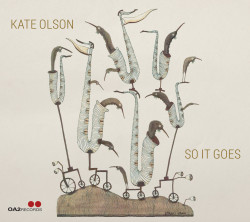
Saxophonist Kate Olson's new album So It Goes will immediately strike American lit fans with its title, which conjures the resigned mantra of acceptance in Slaughterhouse-Five. Released in 1969, Kurt Vonnegut's timeless satire of falling bombs, pointless wars, and chronological confusion remains popular today for reasons that even the uninitiated might guess.
Rest assured, this album does not spend nearly as much time dwelling on the specter of self-imposed human extinction as Vonnegut does. Only the title track, a warmly bittersweet waltz, acknowledges the world's weight directly. Olson's compositions prefer to illustrate simple pleasures, charming bouts of awkward-ness, and the occasional transcendent experience. Maybe not so different than Vonnegut after all?
So It Goes spotlights Olson's "chord-less quartet," where she is joined by Conner Eisenmenger on trombone, Tim Carey on electric bass, and Evan Woodle on drums. Several tracks feature pianist Wayne Horvitz and double bassist Geoff Harper, but even when expanded to a sextet, this record is remarkably light on its feet. Olson's convivial leads are delivered on soprano saxophone exclusively, Carey's tone skews treble, and Woodle's percussion is characteristically nimble.
Past and present, this group's members have occupied prominent roles at Origin Records, The Royal Room, Jazz Night School, the Seattle Repertory Jazz Orchestra, the Racer Sessions, and many other influential Seattle music institutions.
These folks don't just bring life to our stages—they keep the lights on and the wheels turning. It's a credit to Olson's intrepid relationship with the city's music culture that they all find themselves on the same recording.
So It Goes is notably concise for a contemporary jazz album. In an era when crossover opportunities for jazz musicians are blossoming, it's great to experience how compelling "short and sweet" can feel right here on the home court. The album's first half embraces this spirit with tight, energetic compositions that trade extended solos for fast-paced interplay. On "Bumbling Thumbs Blues," the result is more Dixieland ramble than modern jazz odyssey.
That said, every number on this album is different. So It Goes' longest take is a devoted performance of Alice Coltrane's "Translinear Light," on which the band joins voices throughout in a stark juxtaposition to the opener's economically exchanged meters. Rather than sprinting towards a climax, this album spends its second half cooling into contemplation before tumbling through a victory jig on "Weigh Out." In these trying times, it's worth playing a fun, wonderful record like this one and repeating another old Vonnegut saying - "if this isn't nice, I don't know what is."
Rest assured, this album does not spend nearly as much time dwelling on the specter of self-imposed human extinction as Vonnegut does. Only the title track, a warmly bittersweet waltz, acknowledges the world's weight directly. Olson's compositions prefer to illustrate simple pleasures, charming bouts of awkward-ness, and the occasional transcendent experience. Maybe not so different than Vonnegut after all?
So It Goes spotlights Olson's "chord-less quartet," where she is joined by Conner Eisenmenger on trombone, Tim Carey on electric bass, and Evan Woodle on drums. Several tracks feature pianist Wayne Horvitz and double bassist Geoff Harper, but even when expanded to a sextet, this record is remarkably light on its feet. Olson's convivial leads are delivered on soprano saxophone exclusively, Carey's tone skews treble, and Woodle's percussion is characteristically nimble.
Past and present, this group's members have occupied prominent roles at Origin Records, The Royal Room, Jazz Night School, the Seattle Repertory Jazz Orchestra, the Racer Sessions, and many other influential Seattle music institutions.
These folks don't just bring life to our stages—they keep the lights on and the wheels turning. It's a credit to Olson's intrepid relationship with the city's music culture that they all find themselves on the same recording.
So It Goes is notably concise for a contemporary jazz album. In an era when crossover opportunities for jazz musicians are blossoming, it's great to experience how compelling "short and sweet" can feel right here on the home court. The album's first half embraces this spirit with tight, energetic compositions that trade extended solos for fast-paced interplay. On "Bumbling Thumbs Blues," the result is more Dixieland ramble than modern jazz odyssey.
That said, every number on this album is different. So It Goes' longest take is a devoted performance of Alice Coltrane's "Translinear Light," on which the band joins voices throughout in a stark juxtaposition to the opener's economically exchanged meters. Rather than sprinting towards a climax, this album spends its second half cooling into contemplation before tumbling through a victory jig on "Weigh Out." In these trying times, it's worth playing a fun, wonderful record like this one and repeating another old Vonnegut saying - "if this isn't nice, I don't know what is."
Soundclips
Other Reviews of
"So It Goes":
Women in Jazz Magazine by Editor
Exposé Online by Jon Davis
Take Effect by Tom Haugen
Step Tempest by Richard Kamins
Modern Drummer by Editor
The Stranger by Dave Segal
The Seattle Times by Eric Olson
Bman's Blues Report by Editor
Making A Scene by Dee Dee McNeil
Jazz Weekly by George Harris
Paris-Move by Thierry De Clemensat