MUSIC REVIEW BY Ken Dryden, The New York City Jazz Record
Bassist-composer Harvie S—for decades an in-demand player in greater NYC—was born Harvie Swartz in 1948 in Chelsea, MA, but in 2001, frequent misspellings of his surname finally caused him to legally change and simplify it to "S." An alum of Berklee College of Music, Harvie S has developed an extensive discography as a leader, co-leader and sideman, in addition to being a prolific composer. In the '70s, he co-founded the double-vibraphone band Double Image (with David Friedman and Dave Samuels) and he has since become particularly known for his collaborations with the late jazz vocal master Sheila Jordan (1928-2025), as well as with pianists Alan Broadbent, Steve Kuhn and Kenny Barron. He has also co-led albums with guitarists Sheryl Bailey (their duo is known as Plucky Strum) and Roni Ben-Hur. In more recent years, the bassist has additionally
focused on bringing out the true sound of his bass as a recording and mixing engineer.
NEW YORK CITY JAZZ RECORD: Did you grow up in a musical home?
HARVIE S: No. There was a piano for my sister and when I wanted to play it, they told me that I shouldn't because men don't play the piano. I pretty much played by ear. I took some lessons, but everything was classical and I didn't take to it well or to the piano well, for that matter. For me, it works better with the bass!
NYCJR: Were you already interested in jazz when you took up the bass?
HARVIE S: I got into jazz when I was about 15 years old. I played piano, but I wasn't going anywhere. I took a bass out of my high school and messed around on it with a friend of mine who was a good piano player. I had a really crappy stereo at home. I never could hear the bass, because the speakers were so cheap and small, but I ended up buying the Bill Evans' Waltz for Debby record on Riverside (featuring bassist Scott LaFaro). The bass was really recorded well. I could hear it and immediately was drawn to it. I didn't realize what was going on under there, so I got very excited about the bass, but I was still a piano player.
I was completely against the Vietnam War and I was definitely not soldier material, so I decided I'd better go to college. I didn't even want to go and my grades weren't that good, but I could get into Berklee College of Music. I went to Berklee as a composition major with a piano minor. I stayed with it because they didn't have much of a bass department. There wasn't anybody I wanted to study with. So I played bass and piano and kept playing both. I didn't pursue it that seriously, but enough to get me by. But somehow bass worked better for me. My hero, George Mraz, was the number one bass player in school. By my senior year he graduated, and I was picked to take his place. That made me start to think, maybe I got something here.
NYCJR: I've been so impressed with what I've heard in terms of variety: you're constantly exploring new material, in addition to standards and writing songs. You're one of those rare bassists who sounds great in a duo setting, too, whether it's with a singer like Sheila Jordan or with a pianist like Kenny Barron, to where it's a meeting of minds on the same virtuoso level.
HARVIE S: Thank you. I love the duo concept. When I moved to New York, I wasn't much of a duo player and wasn't that experienced. But New York had that cabaret law [initially it prohibited dancing where food and beverages were sold, but was expanded in the '70s to include the "three-musician rule," which restricted venues to no more than three musicians and banned specific instruments], so all the clubs couldn't have drums or saxophones, almost all the jazz gigs around the city were duo gigs, because they were allowed to have duos.
I started playing with pianist-arranger Michael Abene; he's the one who kind of brought me here. I owe him a lot because I didn't even want to come to New York. We would play a month at Bradley's doing duo, I played there with guitarist Jack Wilkins, with Kenny Barron, and I played a lot of duos at the Knickerbocker, the Cookery and Zinno. So through all that I really got my duo playing together. While that was going on, I was in the quartet with Steve Kuhn and I was also playing with Sheila. I'd be on the road with Kuhn, and we would travel all over the world. In those days I traveled with my bass. I'd get to my hotel room, I'd have my bass and I could
practice. So Sheila used to call me and say, "Harvie, bring your bass over, and let's run some tunes." We did that a lot. What I didn't know was that Sheila had a plan. She said, "We have a gig in Philadelphia for WRTI, can you do it?" And I said, 'Yeah' and she gave me the date. I said, 'Who's gonna play piano?' She said nobody. 'So who's gonna play guitar?' She said nobody. I said, 'Wait a minute, there's no piano, no guitar, who's playing drums?' Nobody. 'Sheila, are you talking about that you and I are gonna do a concert together?' She says, "Yeah." I said, 'No, I can't do that, that's too much. I never did anything like that. I don't even know where to begin.' We had a big argument and of course, she won. I said, 'OK, I'll do this gig.' We seriously rehearsed: we had a few months before the gig!
She used to work as a secretary. She did that for years. I lived on 27th Street, and she lived on 18th Street. She would walk home, come by my loft after work, then we would rehearse. My wife and I would make her dinner. We'd have dinner together and a hang and we'd have a good time. Many times I would walk her home because New York was dangerous in those days. Then we did this concert. I told Sheila that I didn't want to read music on the stand. So I would have to memorize everything: 50 tunes and the arrangements. We did the concert and I'm thinking, okay, we'll do this concert. After that, we can get back to using a piano and drums. We played at least an hour. Then we took a break and played another hour. Then we got five standing ovations. I said, 'Oh, maybe, maybe she was right.' Sheila became a very good friend with my first wife. My second wife (Yukimi Maeda) and her were very close friends as well. My wife is a pianist and Sheila sang one tune on her album. We didn't even ask Sheila. She said, "I want to do a tune with you." For 40 years, I've had two 10-inch reels of a concert that we did. I never listened to it until about a month ago. I hope that we're going to get this released because the singing is the most astounding vocal stuff you've ever heard in your life.
NYCJR: Hopefully one of the labels you work with will be interested. It sounds like something that needs to come out.
HARVIE S: It's pretty astounding. I've only listened to one reel, I haven't even listened to the second one yet. The first reel has just got so much in it. It's really a high-quality recording, because it was only two microphones, one on me and one on her.
NYCJR: Speak about your work with (pianist) Alan Broadbent, which has been just as memorable.
HARVIE S: Alan is one of the greatest musicians I have ever known and one of the nicest people, too. He's so brilliant. When I play with him, I can play a solo and if I make a mistake, he'll cover it, because he's got perfect pitch. He knows exactly what to do. He's amazing, his arranging and everything. I'm really honored and have gotten to do more than a half-dozen recordings with him.
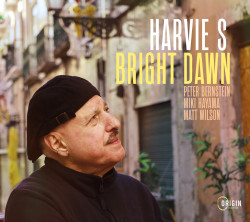
NYCJR: Let's talk about Bright Dawn, your new album. I'm familiar with guitarist Peter Bernstein. I've seen drummer Matt Wilson a number of times over the years, with both Denny Zeitlin and Bill Mays. But pianist Miki Hayama may be a new name for many.
HARVIE S: Miki is becoming one of the hottest players on the scene right now. She just recorded with Dee Dee Bridgewater. She's on the GRAMMY-winning Nnenna Freelon record. She's been touring with saxophonist
Don Braden. I discovered her when I made a record (Homage) with Sheryl Bailey. Miki played Fender Rhodes on it because she's also a keyboardist. She's got to be one of the most swinging piano players, but she can do all the out stuff too. I did a record with Don Friedman and Bernstein (Remembering Attila Zoller). We had also done some gigs together over the years. For me, he's like the heir to Jim Hall, even though he has his own style. A lot of people don't know I worked with Hall for a year and a half. It was when he wasn't recording. What ended my time with Hall was working with Sheila in the duo. I loved playing with Jim, but Jim was insistent
that I make all the gigs and I had duo gigs, which I couldn't sub out for. So I lost the gig with him. I played with Peter and I felt that he would be really good for this project. Matt and I have played together on and off on records over a long period of time. The thing about Matt is wherever you go, he's right there. If you want to play really simple and straight ahead, he's there. You want to play more creative, he's there. He doesn't play the drums, he plays the music. So I handpicked this band. A lot of thought went into what I thought would be the best combination and I'm really happy with the results.
NYCJR: One of Matt's expressions is, "What does the music need?"
HARVIE S: Well, that's exactly how he is. I've made over 20 records as a leader. All the records I made were more conceptual. They weren't featuring the bass at all. I took some solos and I played a little bit of melody. But this record, Bright Dawn, I decided I'm going to really step out. I'm really playing a lot of melodies. I'm bowing on it. I really took the lead in this record.
focused on bringing out the true sound of his bass as a recording and mixing engineer.
NEW YORK CITY JAZZ RECORD: Did you grow up in a musical home?
HARVIE S: No. There was a piano for my sister and when I wanted to play it, they told me that I shouldn't because men don't play the piano. I pretty much played by ear. I took some lessons, but everything was classical and I didn't take to it well or to the piano well, for that matter. For me, it works better with the bass!
NYCJR: Were you already interested in jazz when you took up the bass?
HARVIE S: I got into jazz when I was about 15 years old. I played piano, but I wasn't going anywhere. I took a bass out of my high school and messed around on it with a friend of mine who was a good piano player. I had a really crappy stereo at home. I never could hear the bass, because the speakers were so cheap and small, but I ended up buying the Bill Evans' Waltz for Debby record on Riverside (featuring bassist Scott LaFaro). The bass was really recorded well. I could hear it and immediately was drawn to it. I didn't realize what was going on under there, so I got very excited about the bass, but I was still a piano player.
I was completely against the Vietnam War and I was definitely not soldier material, so I decided I'd better go to college. I didn't even want to go and my grades weren't that good, but I could get into Berklee College of Music. I went to Berklee as a composition major with a piano minor. I stayed with it because they didn't have much of a bass department. There wasn't anybody I wanted to study with. So I played bass and piano and kept playing both. I didn't pursue it that seriously, but enough to get me by. But somehow bass worked better for me. My hero, George Mraz, was the number one bass player in school. By my senior year he graduated, and I was picked to take his place. That made me start to think, maybe I got something here.
NYCJR: I've been so impressed with what I've heard in terms of variety: you're constantly exploring new material, in addition to standards and writing songs. You're one of those rare bassists who sounds great in a duo setting, too, whether it's with a singer like Sheila Jordan or with a pianist like Kenny Barron, to where it's a meeting of minds on the same virtuoso level.
HARVIE S: Thank you. I love the duo concept. When I moved to New York, I wasn't much of a duo player and wasn't that experienced. But New York had that cabaret law [initially it prohibited dancing where food and beverages were sold, but was expanded in the '70s to include the "three-musician rule," which restricted venues to no more than three musicians and banned specific instruments], so all the clubs couldn't have drums or saxophones, almost all the jazz gigs around the city were duo gigs, because they were allowed to have duos.
I started playing with pianist-arranger Michael Abene; he's the one who kind of brought me here. I owe him a lot because I didn't even want to come to New York. We would play a month at Bradley's doing duo, I played there with guitarist Jack Wilkins, with Kenny Barron, and I played a lot of duos at the Knickerbocker, the Cookery and Zinno. So through all that I really got my duo playing together. While that was going on, I was in the quartet with Steve Kuhn and I was also playing with Sheila. I'd be on the road with Kuhn, and we would travel all over the world. In those days I traveled with my bass. I'd get to my hotel room, I'd have my bass and I could
practice. So Sheila used to call me and say, "Harvie, bring your bass over, and let's run some tunes." We did that a lot. What I didn't know was that Sheila had a plan. She said, "We have a gig in Philadelphia for WRTI, can you do it?" And I said, 'Yeah' and she gave me the date. I said, 'Who's gonna play piano?' She said nobody. 'So who's gonna play guitar?' She said nobody. I said, 'Wait a minute, there's no piano, no guitar, who's playing drums?' Nobody. 'Sheila, are you talking about that you and I are gonna do a concert together?' She says, "Yeah." I said, 'No, I can't do that, that's too much. I never did anything like that. I don't even know where to begin.' We had a big argument and of course, she won. I said, 'OK, I'll do this gig.' We seriously rehearsed: we had a few months before the gig!
She used to work as a secretary. She did that for years. I lived on 27th Street, and she lived on 18th Street. She would walk home, come by my loft after work, then we would rehearse. My wife and I would make her dinner. We'd have dinner together and a hang and we'd have a good time. Many times I would walk her home because New York was dangerous in those days. Then we did this concert. I told Sheila that I didn't want to read music on the stand. So I would have to memorize everything: 50 tunes and the arrangements. We did the concert and I'm thinking, okay, we'll do this concert. After that, we can get back to using a piano and drums. We played at least an hour. Then we took a break and played another hour. Then we got five standing ovations. I said, 'Oh, maybe, maybe she was right.' Sheila became a very good friend with my first wife. My second wife (Yukimi Maeda) and her were very close friends as well. My wife is a pianist and Sheila sang one tune on her album. We didn't even ask Sheila. She said, "I want to do a tune with you." For 40 years, I've had two 10-inch reels of a concert that we did. I never listened to it until about a month ago. I hope that we're going to get this released because the singing is the most astounding vocal stuff you've ever heard in your life.
NYCJR: Hopefully one of the labels you work with will be interested. It sounds like something that needs to come out.
HARVIE S: It's pretty astounding. I've only listened to one reel, I haven't even listened to the second one yet. The first reel has just got so much in it. It's really a high-quality recording, because it was only two microphones, one on me and one on her.
NYCJR: Speak about your work with (pianist) Alan Broadbent, which has been just as memorable.
HARVIE S: Alan is one of the greatest musicians I have ever known and one of the nicest people, too. He's so brilliant. When I play with him, I can play a solo and if I make a mistake, he'll cover it, because he's got perfect pitch. He knows exactly what to do. He's amazing, his arranging and everything. I'm really honored and have gotten to do more than a half-dozen recordings with him.
NYCJR: Let's talk about Bright Dawn, your new album. I'm familiar with guitarist Peter Bernstein. I've seen drummer Matt Wilson a number of times over the years, with both Denny Zeitlin and Bill Mays. But pianist Miki Hayama may be a new name for many.
HARVIE S: Miki is becoming one of the hottest players on the scene right now. She just recorded with Dee Dee Bridgewater. She's on the GRAMMY-winning Nnenna Freelon record. She's been touring with saxophonist
Don Braden. I discovered her when I made a record (Homage) with Sheryl Bailey. Miki played Fender Rhodes on it because she's also a keyboardist. She's got to be one of the most swinging piano players, but she can do all the out stuff too. I did a record with Don Friedman and Bernstein (Remembering Attila Zoller). We had also done some gigs together over the years. For me, he's like the heir to Jim Hall, even though he has his own style. A lot of people don't know I worked with Hall for a year and a half. It was when he wasn't recording. What ended my time with Hall was working with Sheila in the duo. I loved playing with Jim, but Jim was insistent
that I make all the gigs and I had duo gigs, which I couldn't sub out for. So I lost the gig with him. I played with Peter and I felt that he would be really good for this project. Matt and I have played together on and off on records over a long period of time. The thing about Matt is wherever you go, he's right there. If you want to play really simple and straight ahead, he's there. You want to play more creative, he's there. He doesn't play the drums, he plays the music. So I handpicked this band. A lot of thought went into what I thought would be the best combination and I'm really happy with the results.
NYCJR: One of Matt's expressions is, "What does the music need?"
HARVIE S: Well, that's exactly how he is. I've made over 20 records as a leader. All the records I made were more conceptual. They weren't featuring the bass at all. I took some solos and I played a little bit of melody. But this record, Bright Dawn, I decided I'm going to really step out. I'm really playing a lot of melodies. I'm bowing on it. I really took the lead in this record.
Soundclips
Other Reviews of
"Bright Dawn":
JazzWise (UK) by Victoria Kingham
Take Effect by Tom Haugen
JazzTimes by James Gavin
Modern Drummer by Editor
The New York City Jazz Record by Pierre Giroux
Bman's Blues Report by Editor
Marlbank (UK) by Stephen Graham
UK Jazz News by Francesco Spezia
Making A Scene by Dee Dee McNeil
Jazz Weekly by George W Harris
Bass Musician Magazine by Karen Beishuizen
Paris-Move by Thierry De Clemensat