MUSIC REVIEW BY James Gavin, JazzTimes
Throughout his five decades in jazz, bassist Harvie S has grown from a solid, swinging timekeeper into a musician who has earned his place in the foreground. Like his key inspiration, Bill Evans's early bassist Scott LaFaro, he has turned the bass into a melodic instrument, full of expressive possibilities. He colors his sweet tone with slides, growls, wit and drama, while phrasing like a singer: a flair he absorbed, no doubt, from his long duo partnership with the late Sheila Jordan.
His new album, Bright Dawn, spotlights him as a composer — one who writes with the same lyricism and architecture that mark his playing. Never does he indulge in tuneless blowing sessions that masquerade as songs; his pieces set interesting themes that go someplace.
Bright Dawn is full of concisely stated themes, meaningfully employed space, and spare, no-nonsense solos. The bassist chose a set of colleagues — guitarist Peter Bernstein, Miki Hayama on piano and keyboards, drummer Matt Wilson — who, like him, know how to make forceful statements with a light touch.
Every track has a distinct personality and an idea behind it. "Ghosts of Havana" comes from a period in which the leader studied music in Cuba; it combines a rhumba feeling with a dark, tiptoeing bass line that lends it a sinister undertone. "Waltz for Vartan" is dedicated to his friend Vartan Tonoian, owner of the now-defunct Denver jazz club Vartan Jazz. The piece's airy, spinning quality evokes "Waltz for Debby," the Evans composition recorded at his last album date with LaFaro, who died ten days later at 25.
"Navalny" pays homage to Alexei Navalny, the Russian activist and political prisoner whose life ended somewhat mysteriously in 2024. Harvie S sets the scene with an atmosphere of starkness and desolation, then a flood of emotion takes over. The whimsical "I've Got Rhythm and Blues" combines the chords of "I Got Rhythm" with a blues bridge. He and Peter Bernstein switch from unison playing to counterpoint with graceful ease. Here and elsewhere, Matt Wilson both kicks and floats, keeping things swinging while never overpowering the band. "The Truth" pays homage to Barry Harris. This vision of the late bop pianist is slow and funereal; in a bowed bass solo, the bent notes cry out with feeling.
Two non-originals shed further light on what the bassist values in the art of composing. Bob Dorough's jazz standard "Devil May Care" is a bebop obstacle course that's also full of swinging good fun. Chick Corea's "Humpty Dumpty" comes from his Alice in Wonderland-inspired 1978 album Mad Hatter. Its daunting harmonies, rhythms and shifting dynamics made it a showpiece for Corea's bass players Eddie Gómez; since then, the tune has been a decathlon for countless other bassists. By giving it with a whimsical, dancing quality and not a hint of stress, Harvie S makes it his own.
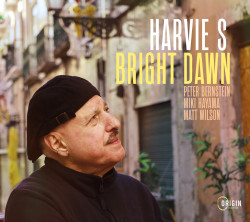
His new album, Bright Dawn, spotlights him as a composer — one who writes with the same lyricism and architecture that mark his playing. Never does he indulge in tuneless blowing sessions that masquerade as songs; his pieces set interesting themes that go someplace.
Bright Dawn is full of concisely stated themes, meaningfully employed space, and spare, no-nonsense solos. The bassist chose a set of colleagues — guitarist Peter Bernstein, Miki Hayama on piano and keyboards, drummer Matt Wilson — who, like him, know how to make forceful statements with a light touch.
Every track has a distinct personality and an idea behind it. "Ghosts of Havana" comes from a period in which the leader studied music in Cuba; it combines a rhumba feeling with a dark, tiptoeing bass line that lends it a sinister undertone. "Waltz for Vartan" is dedicated to his friend Vartan Tonoian, owner of the now-defunct Denver jazz club Vartan Jazz. The piece's airy, spinning quality evokes "Waltz for Debby," the Evans composition recorded at his last album date with LaFaro, who died ten days later at 25.
"Navalny" pays homage to Alexei Navalny, the Russian activist and political prisoner whose life ended somewhat mysteriously in 2024. Harvie S sets the scene with an atmosphere of starkness and desolation, then a flood of emotion takes over. The whimsical "I've Got Rhythm and Blues" combines the chords of "I Got Rhythm" with a blues bridge. He and Peter Bernstein switch from unison playing to counterpoint with graceful ease. Here and elsewhere, Matt Wilson both kicks and floats, keeping things swinging while never overpowering the band. "The Truth" pays homage to Barry Harris. This vision of the late bop pianist is slow and funereal; in a bowed bass solo, the bent notes cry out with feeling.
Two non-originals shed further light on what the bassist values in the art of composing. Bob Dorough's jazz standard "Devil May Care" is a bebop obstacle course that's also full of swinging good fun. Chick Corea's "Humpty Dumpty" comes from his Alice in Wonderland-inspired 1978 album Mad Hatter. Its daunting harmonies, rhythms and shifting dynamics made it a showpiece for Corea's bass players Eddie Gómez; since then, the tune has been a decathlon for countless other bassists. By giving it with a whimsical, dancing quality and not a hint of stress, Harvie S makes it his own.
Soundclips
Other Reviews of
"Bright Dawn":
JazzWise (UK) by Victoria Kingham
Take Effect by Tom Haugen
Modern Drummer by Editor
The New York City Jazz Record by Pierre Giroux
Bman's Blues Report by Editor
Marlbank (UK) by Stephen Graham
The New York City Jazz Record by Ken Dryden
UK Jazz News by Francesco Spezia
Making A Scene by Dee Dee McNeil
Jazz Weekly by George W Harris
Bass Musician Magazine by Karen Beishuizen
Paris-Move by Thierry De Clemensat