MUSIC REVIEW BY Dee Dee McNeil, Making A Scene
Abate Berihun is one of the most vital and influential voices in contemporary Ethiopian and Jewish diasporic music. His vocals sound like he's praying. They are earthy incantations that soar and rise from quiet chants to skyward cries. His saxophone comes on the scene after he sings the opening tune titled, "Tefila" that translate to "Prayer." The instrument's tone is warm as fresh honey from the hive, both persuasive and sweet.
Berihun's world music is a combination of Ethiopian and Jewish liturgical traditions. It floats atop African rhythms and the modern jazz language. On the title song, "Addis Ken," produced as an instrumental without Abate Berihun's vocals, Roy Mor's piano is king. The bass of David Michaeli opens the arrangement and Berihun's saxophone punches out the melodic story of a life deeply rooted in Africa, but also rich with Jewish spirituality and American jazz. There is something quite wonderful that flows from the horn of Abate Berihun. It hangs in the air above my head like an incantation, pulsating in space with a melody that is memorable.
All the compositions on this album are written by Abate Berihun, Roy Mor, David Michaeli and Nitzan Birnbaum except two songs. "One for Roy" was penned by Michaeli alone, and their closing song, "Batti" is a traditional song about a man longing for his beloved and following her to a market town called Batti.
This music represents the Beta Israel community of Ethiopia. The lyrics are sung in Ge'ez, a sacred endangered language transmitted orally for nearly two thousand years. The Addis Ken Project contains texts from the Psalms, woven into these jazz melodies, with rhythms that sound like an international heartbeat.
A tune called "Des Des" unfolds as a jazz waltz. It has Afro-Latin inflections and spews joy all over my listening room. There is something very Coltrane-ish about this music. Coltrane was also always seeking to gain spiritual awakening and play it inside his music. I feel the music of Abate Berihun strives for the same thing.
"One for Roy" is played in 5/4 time, with Berihun's voice singing the Ge'ez language over the chords near the close of the song. This is followed by the lovely ballad, "Geshen" (that translates to rain). This music sooths and comforts. The arrangement snuggles into my ears and touches my heart. Then comes a tune that sounds like fusion jazz. It's titled "Ya Zaman" and exhibits Nitzan Birnbaum exploring a funk groove on his drums.
On "Behatitu Kadus Kadus" that means "You Alone Are Holy" represents the Ethiopian Jewish priests chanting the liturgy in a call-and-response manner. The blues is threaded through this music like golden threads. It also whispers of the Gospel, with roots carried over to the Baptist American church music. Guest vocalist Rudi Bainesay performs on this song and the following composition of "Adam" that translates to 'human' explores the story of the garden of Eden. It celebrates a tale that echoes around the world as the biblical beginning of humanity. This is an album I will play over and over again, each time lifted by the spirit of Abate Berihun's music and intention.
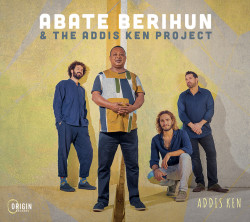
Berihun's world music is a combination of Ethiopian and Jewish liturgical traditions. It floats atop African rhythms and the modern jazz language. On the title song, "Addis Ken," produced as an instrumental without Abate Berihun's vocals, Roy Mor's piano is king. The bass of David Michaeli opens the arrangement and Berihun's saxophone punches out the melodic story of a life deeply rooted in Africa, but also rich with Jewish spirituality and American jazz. There is something quite wonderful that flows from the horn of Abate Berihun. It hangs in the air above my head like an incantation, pulsating in space with a melody that is memorable.
All the compositions on this album are written by Abate Berihun, Roy Mor, David Michaeli and Nitzan Birnbaum except two songs. "One for Roy" was penned by Michaeli alone, and their closing song, "Batti" is a traditional song about a man longing for his beloved and following her to a market town called Batti.
This music represents the Beta Israel community of Ethiopia. The lyrics are sung in Ge'ez, a sacred endangered language transmitted orally for nearly two thousand years. The Addis Ken Project contains texts from the Psalms, woven into these jazz melodies, with rhythms that sound like an international heartbeat.
A tune called "Des Des" unfolds as a jazz waltz. It has Afro-Latin inflections and spews joy all over my listening room. There is something very Coltrane-ish about this music. Coltrane was also always seeking to gain spiritual awakening and play it inside his music. I feel the music of Abate Berihun strives for the same thing.
"One for Roy" is played in 5/4 time, with Berihun's voice singing the Ge'ez language over the chords near the close of the song. This is followed by the lovely ballad, "Geshen" (that translates to rain). This music sooths and comforts. The arrangement snuggles into my ears and touches my heart. Then comes a tune that sounds like fusion jazz. It's titled "Ya Zaman" and exhibits Nitzan Birnbaum exploring a funk groove on his drums.
On "Behatitu Kadus Kadus" that means "You Alone Are Holy" represents the Ethiopian Jewish priests chanting the liturgy in a call-and-response manner. The blues is threaded through this music like golden threads. It also whispers of the Gospel, with roots carried over to the Baptist American church music. Guest vocalist Rudi Bainesay performs on this song and the following composition of "Adam" that translates to 'human' explores the story of the garden of Eden. It celebrates a tale that echoes around the world as the biblical beginning of humanity. This is an album I will play over and over again, each time lifted by the spirit of Abate Berihun's music and intention.
Soundclips
Other Reviews of
"Addis Ken":
Songlines (UK) by Kwanele Sosibo
Take Effect by Tom Haugen
Tenoua (Paris) by Antoine Kauffer
Cult News (Paris) by Hanna Kay
Rudolf Radnai by Budapest
Bman's Blues Report by Editor
Le Quotidien (Senegal) by Malick Gaye
Step Tempest by Richard Kamins
UK Vibe by Mike Gates
Jazz Weekly by George Harris
Paris Move by Thierry De Clemensat