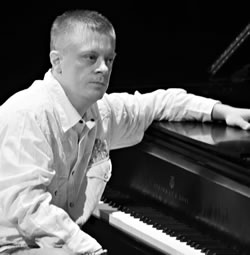
Dedic's phrasing is unpredictable and exciting, and he has a very definite time-feel that is all his own.
March 2, 1973 - June 8, 2025
In memoriam: Matija Dedić (1973 - 2025) - the Sunday when we lost the second Dedić
Have we just lost our best jazz pianist? We did. We are only now aware, many of us, that Matija Dedić was exactly that.
That jazz among Croats is strange. It is full of talents, even greater workers, and there are visionaries. But, well, it's never an overly sounding media topic, even though it's about sound. In our world, his father Arsen Dedić was a more resounding media commodity. The undisputed poet who described us and carved the nature of our game forever. Like Krleža. We can mess around as much as we want, but we'll mess around the way the bard wrote.
And then how does Matija? And jazz on top of that. How can it become more resonant in that world? Matija was not a giant of words and thoughts, like his father, but he had that strength and virtuosity in his fingers. There were his words, his thoughts. What Arsen was among poets, Matija was among musicians. A giant of black and white keys. An unbeatable gift for a new generation.
But he was a good soul towards, you can really say, almost all musicians. There were no genres for him. The impression is that hardly anyone who asked him for cooperation or guest appearances was rejected. And without any exaggeration, everyone with Matija got an aura that they did not have before. If Matija is your guest, it is as if you have received a diploma. He himself never communicated it as some boastful achievement. It was normal for him to help a musician as a musician. He understood other people's efforts. He respected the work. Because he was also one of those who gained everything through work, because that was the only way Dedić could be outside the shadow of Dedić senior. He also became our first jazz star after Boško Petrović, seen in the broader picture among the population. Something like this is achieved only through work and talent.
As I write this, my Facebook wall is full of farewell messages and thoughts from the many people he has worked with. From everywhere. From Croatia, Bosnia and Herzegovina, Serbia, Macedonia, Slovenia... A multitude of people with whom he played, a multitude of sincere messages caught in pain. Matija was there like his father. Sincerely appreciated and welcome in every environment of this region of ours. Star. A true Yugoslav star after Yugoslavia. But there you have it, jazz... It's never sound good enough where we are. However, we should stop here before someone thinks that Matija, well, pampered everyone. We have to get into that jazz, because we need to try to shed light on things as much as possible in this painful moment.
I remember the year 2008 when the Brad Mehldau Trio performed at the Zagreb Jazz Festival on the last day, which took us to another dimension, not only jazz, but music. Matija, who during his lifetime did not miss the opportunity to catch Keith Jarrett at a concert in Europe - in a way his spiritual and musical mentor who had never personally been in that role - did not calm down until he recorded an album with the rhythm section of the Brad Mehldau Trio. With the best.
Music is communication. And when it comes to jazz, it's a communication equal to the philosophical level of the best. In this sense, even the best gravitate towards the best. You strive for your own equals. So Matija followed that impulse. He has always followed him. All you have to do is take the Boilers Quartet in the line-up of Dedić-Križić-Baraković-Levačić. After their performances in London, the renowned Time magazine included them in the shortlist of the best jazz bands outside the United Kingdom.
When after Arsen's departure there was a void that no one could fill on the stage and when no one overly delved into his rich and significant legacy, Matija filled that space. The album "Matija plays Arsena" was an instant return of his father's work through his son's fingers - full of sensibility in expression and sound messages that resonate like words in verses. It was a re-established connection between son and father through music.
On stage, carried away by inspiration, he often knew how to be elusive playful, just as he used to put the accompanying musicians in trouble when he changed the key during the play, and then at the end of the performance he would only laconically say to the musicians: "I modulated." So, for him, this space of communication through music has always been open and lively, like verbal communication that can often go in an unexpected direction. He was always on a journey of exploration, because as much as he knew about music, he was driven by an almost boyish curiosity to learn more, because music was an enigma to him no matter how much he was a whole being in it - wherever it took him, it seemed to modulate and constantly opened some new doors for him. Matija seems to have always been ready for this game in order to follow those enigmatic modulations and possibilities that music opens up.
His life mission was abruptly interrupted, turning a seemingly ordinary Sunday evening into a sudden shock, opening up space for the difficult conclusion that the Almighty sometimes takes the best for himself early.
In a little less than ten years, we have lost two musical pillars of our not so large scene. We lost two Dedićs who left us a lot of their fruitful work, but also the shock of a huge emptiness after their departure. The shock for Matija does not subside, while we look for a ray of comfort in the thought that father and son are together again in another world where the music does not stop.
RAVNO DO DNA Magazin Pop Kulture (Croatia) - 09/06/2025 by Zoran Stajčić
Born in Zagreb on March 2, 1973, Matija started playing classic piano at the age of five. After he finished Music high school Vatroslav Lisinski in 1991, he went to the Jazz Academy in Graz, Austria where he graduated in 1997. He studied under Professor Harald Neuwirth, and private lessons with John Taylor in Cologne, Hal Galper, Bill Dobbins and Barry Harris.
Since he was raised in a family surrounded by pop and traditional musicians, he began to listen to all kinds of music very early, soon discovering jazz and finding that it allowed him an abstract and more personal musical point of view.
After returning to Zagreb in 1997, he began to play more often and his work was recognized in and out of Croatia. During those years he played with his own band "Boliers Quartet," with whom he supported the likes of Benny Golson, Kenny Burrell, Roy Haynes, Jose Feliciano and an "All Star Band". Meanwhile he also had a chance to play in the "Tamara Obrovac Quartet."
Over the years he played in Italy, Germany, Slovakia, England, Brazil, Belgium, Turkey, Spain, Austria, Slovenia, Serbia, FYR of Macedonia, France, Denmark, Sweden, Switzerland, Hungary, Greece, and the USA with names such as Alvin Queen, Martin Drew, Ron Ringwood, Boko Petrovic, Marc Murphy Band, Patrizia Conte, David Gazarov, Gianni Basso, Miles Griffith, Onder Fokan, J.L. Rassinfosse, Anca Parghel, Tomi Emanuel, Lenny White, Kendrick Scott, Jim Madison, Jeff Ballard, Vicente Archer, Buster Wiliams, Larry Grenadier, N.H.O. Pedersen, Ron Mcclure, Tamara Obrovac, Marek Patrman, Salvatore Maiore, and more.
He writes music for television and theatre, and also occasionally plays with some big pop names on the Croatian music scene. Croatian authors society awarded him for the album "Octopussy" as the best author and best jazz newcomer in the last 10 years.
In July 2002, Matija performed on the Montreux Jazz Festival in France, as one of the 11 finalists that were chosen from more than 400 pianists around the world. His father Arsen Dedic was Yugoslavia's most famous singer/songwriter and received the Italian Premio Tenco Award and the Jacques Brel award, and his mother, the famous pop and jazz singer Gabi Novak, during her long career sang with Louis Armstrong, Gary Burton, Phil Woods, Toots Thielemans, Helen Merril, and Joe Turner, among many others.
RECORDINGS FEATURING Matija Dedic
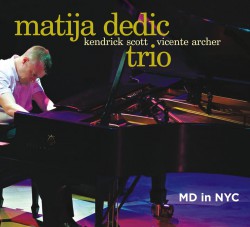
ARTIST WEBSITE:
For more information about Matija Dedic, please visit: http://matijadedic.com/.
ARTIST VIDEO:

Explore other Pianists:
Clay Giberson
Marius Nordal
Marc Seales
Pax Wallace
Randy Halberstadt
Ryan Burns
Bill Anschell
Jessica Williams
Glenn Zaleski
Geoffrey Keezer
Toby Koenigsberg
Laurence Hobgood
Geoff Stradling
Hal Galper
Darrell Grant
Jim McNeely
Ron Di Salvio
Kelly Brand
Dawn Clement
Steve Million
John Hansen
Jon Alberts
Bram Weijters
Paul Hofmann
Richard Sussman
Michal Vanoucek
Alex Chadsey
Stu Katz
Brittany Anjou
Ryan Cohan
Ron Perrillo
Gary Versace
Darin Clendenin
Dan Cray
Dick Reynolds
Ted Brancato
George Colligan
Dominic J. Marshall
Jerry Heldman
Gene Argel
Josh Nelson
Michael Orenstein
Richie Beirach
Jack Perla
Florian Hoefner
Oscar Hernández
Bongwool Lee
Orrin Evans
Alain Mallet
Joachim Mencel
Sean Michael Giddings
Phillip Strange
Jim Ridl
Dylan Hayes
Bruce Barth
Rick Roe
Adam Benjamin
Keigo Hirakawa
Pamela York
Gabriel Guerrero
Chuck Owen
Fabian Almazan
Danny Grissett
Dave Hanson
José Luiz Martins
Milan Verbist
Jovino Santos Neto
Bill Mays
Roy Mor
Simona Premazzi
Bob Nell